
-
The BladeForums.com 2024 Traditional Knife is available! Price is $250 ea (shipped within CONUS).
Order here: https://www.bladeforums.com/help/2024-traditional/
You are using an out of date browser. It may not display this or other websites correctly.
You should upgrade or use an alternative browser.
You should upgrade or use an alternative browser.
WIP: Designing and building the new Resolute with the help of CNC.
- Thread starter aarongough
- Start date

- Joined
- Mar 12, 2013
- Messages
- 1,167
"Not to scale -Duh"
View attachment 555423
Haha, that made me laugh out loud!
Brian.Evans
Registered Member
- Joined
- Aug 20, 2011
- Messages
- 3,267
Well, I just didn't want you to mistake it for a technical drawing and end up messing something up on your fancy 'puter muhsheen, lol.Haha, that made me laugh out loud!
I'm excited for you! Good luck with full time!!
- Joined
- Mar 12, 2013
- Messages
- 1,167
The clamp as it stands seems to work well enough for the moment! Once I get the 'downcut' endmills all the force will be downward pushing the part onto the fixture anyway, so I think I'm sorted!
I've been talking to Frank, the owner of Maritool, about the downcut endmills. He has very kindly offered to add them as a stock item! He will be stocking 1/4", 3/8" and 1/2" versions with the 3/8" version being around $25. They will be 4 flute solid carbide AITiN coated endmills which will be great for working on steel!
I had a chat to another well known company that specializes in custom tooling, they quoted $275 each for the 3/8" downcut endmills, with a minimum quantity of 3... So Frank is doing me a huge favour by adding the tools to his catalogue!
For the last 2 days I've been working on a fixture and toolpaths for partially milling the bevels on the machine! Easily the most complicated fixture I've had to make so far, simply because the angles and overall positions need to be incredibly precise. I used a large angle table to set everything up, here you can see the setup I used for milling the angles onto the fixture:
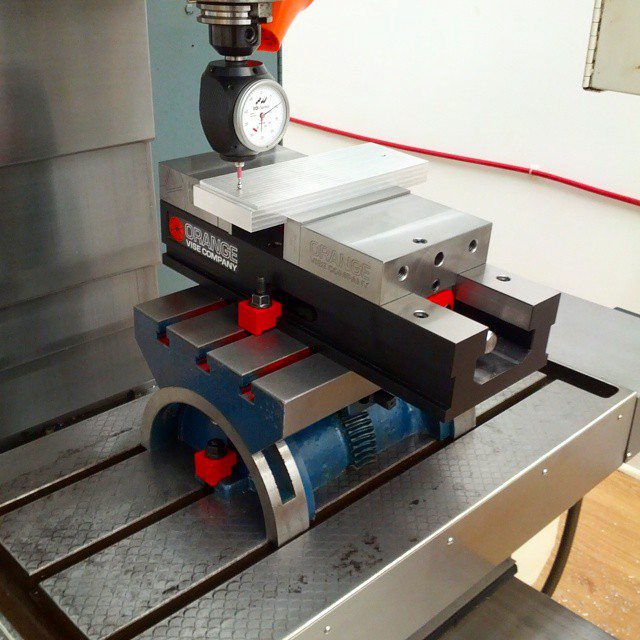
The angle table was probably a mistake unfortunately. Its adjustments are far too coarse to be all that useful. I ended up dialling it in by using my Haimer indicator to measure the slope across a 1" section of the workpiece. This got me very close but in the end I had to make some adjustments by lapping the back of the fixture and focusing on one side. I removed about 0.0015" and it's very nearly perfect now, I think I need to remove about another 0.0005" and then it should be good! This is what the final fixture looks like:
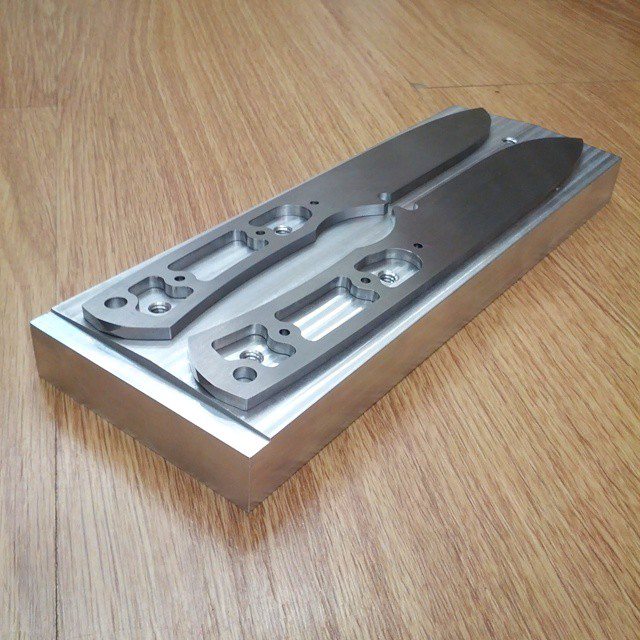
The fixture is mounted in the vise, then clamps go over the top of the tangs and tips of the blades to hold everything in place. The bevels are machined in a spiral pattern starting right in the middle where the material is weakest, that way the remaining material is still there to support it. The tool then works its way outwards to where the material is best supported. Seems to work very well!
The main point of doing this was to make it much easier to get the plunge lines perfectly consistent. We all know how much of a pain that can be and it really wasn't something I wanted to have to deal with on potentially dozens of knives.
After much tuning of the fixture and toolpaths the blades are coming out quite nicely! Took me seven attempts to get to this stage:
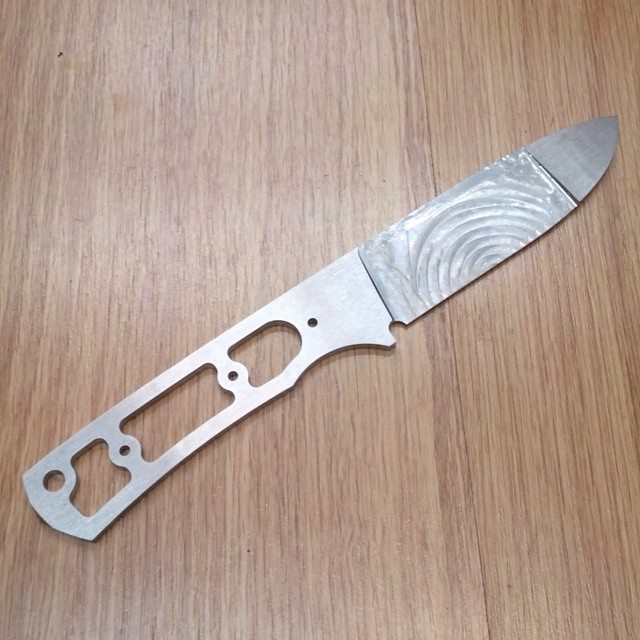
To some extent I'm a little amazed that it actually worked! The edge is only 0.012" thick so it was an open question for me whether it would simply get deflected and chewed up... Seems the tactic of starting right in the middle works very well!
The spiral pattern is something you can see, but not really feel at all. Feels very smooth to the fingertips. I have to finish the tip of the blade on the belt grinder anyway, so when I'm doing that I will do a quick finish pass over the rest of the blade to blend everything in, should work out well I think!
I'm pleased with the process I'm making so far! I still have to finalize the bevel jig, then I need to work on optimizing the toolpaths for the handle scales, then I'll be onto working on the sheaths!
The plan for the sheaths is to make a fixture/mould that serves both as a vacuum forming mould to actually shape the hot kydex, then when it cools down the vacuum will be left on to hold them in place so they can be cut out! Not sure yet how that's going to work but I'm hoping it will go well!
-Aaron
I've been talking to Frank, the owner of Maritool, about the downcut endmills. He has very kindly offered to add them as a stock item! He will be stocking 1/4", 3/8" and 1/2" versions with the 3/8" version being around $25. They will be 4 flute solid carbide AITiN coated endmills which will be great for working on steel!
I had a chat to another well known company that specializes in custom tooling, they quoted $275 each for the 3/8" downcut endmills, with a minimum quantity of 3... So Frank is doing me a huge favour by adding the tools to his catalogue!
For the last 2 days I've been working on a fixture and toolpaths for partially milling the bevels on the machine! Easily the most complicated fixture I've had to make so far, simply because the angles and overall positions need to be incredibly precise. I used a large angle table to set everything up, here you can see the setup I used for milling the angles onto the fixture:
The angle table was probably a mistake unfortunately. Its adjustments are far too coarse to be all that useful. I ended up dialling it in by using my Haimer indicator to measure the slope across a 1" section of the workpiece. This got me very close but in the end I had to make some adjustments by lapping the back of the fixture and focusing on one side. I removed about 0.0015" and it's very nearly perfect now, I think I need to remove about another 0.0005" and then it should be good! This is what the final fixture looks like:
The fixture is mounted in the vise, then clamps go over the top of the tangs and tips of the blades to hold everything in place. The bevels are machined in a spiral pattern starting right in the middle where the material is weakest, that way the remaining material is still there to support it. The tool then works its way outwards to where the material is best supported. Seems to work very well!
The main point of doing this was to make it much easier to get the plunge lines perfectly consistent. We all know how much of a pain that can be and it really wasn't something I wanted to have to deal with on potentially dozens of knives.
After much tuning of the fixture and toolpaths the blades are coming out quite nicely! Took me seven attempts to get to this stage:
To some extent I'm a little amazed that it actually worked! The edge is only 0.012" thick so it was an open question for me whether it would simply get deflected and chewed up... Seems the tactic of starting right in the middle works very well!
The spiral pattern is something you can see, but not really feel at all. Feels very smooth to the fingertips. I have to finish the tip of the blade on the belt grinder anyway, so when I'm doing that I will do a quick finish pass over the rest of the blade to blend everything in, should work out well I think!
I'm pleased with the process I'm making so far! I still have to finalize the bevel jig, then I need to work on optimizing the toolpaths for the handle scales, then I'll be onto working on the sheaths!
The plan for the sheaths is to make a fixture/mould that serves both as a vacuum forming mould to actually shape the hot kydex, then when it cools down the vacuum will be left on to hold them in place so they can be cut out! Not sure yet how that's going to work but I'm hoping it will go well!
-Aaron
- Joined
- Mar 12, 2013
- Messages
- 1,167
Today I finished up machining all the clamps for the bevel fixture:
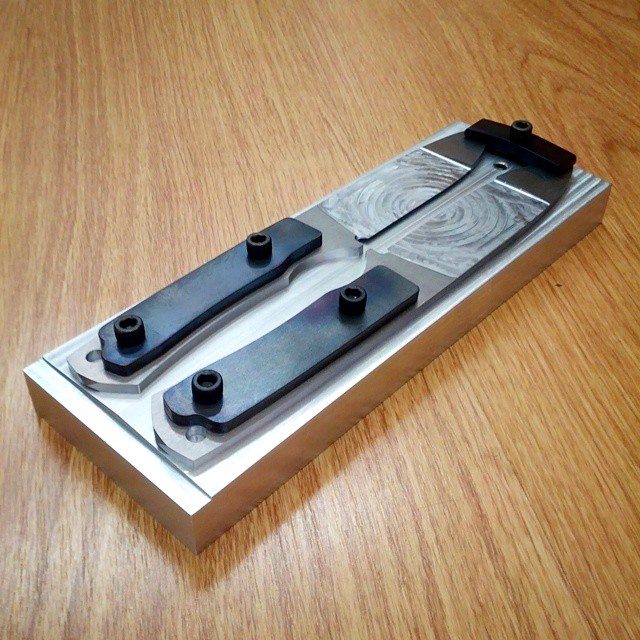
The tang clamps are bent about 0.050" near their tips to ensure they press down as closely to the plunge line as possible.
The tip clamp is quite stout at 1/4" thick and only 2" long, I had to heat it to 1700°F before bending it! The tip clamp is machined on the underside to provide a recess so that it sits on the blades in a specific location, without that the clamp would be easy to misalign and it might get in the way of a tool!
The two tang clamps are made from A2 and the tip clamp is made from 5160. All were hardened and then spring tempered. Bit of a time consuming thing, but it will hopefully make them last forever!
The fixture now consists of 4 unique components (not including the fasteners), in total the parts required 11 separate setups to make and most setups had 3 or more machining operations... All told this fixture has taken me about 2-1/2 days of work. Still not as quick as I could be on the CAD/CAM/Machining cycle, but I'm getting there!
Went and bought a 1/4" hex impact driver today, a nice light Milwaukee M12 one to use for fastening/unfastening all the screws on the fixtures. I've standardized on 1/4-20 socket head cap screws so that I can use one bit to deal with any of the fixtures, should work out well I think!
The tang clamps are bent about 0.050" near their tips to ensure they press down as closely to the plunge line as possible.
The tip clamp is quite stout at 1/4" thick and only 2" long, I had to heat it to 1700°F before bending it! The tip clamp is machined on the underside to provide a recess so that it sits on the blades in a specific location, without that the clamp would be easy to misalign and it might get in the way of a tool!
The two tang clamps are made from A2 and the tip clamp is made from 5160. All were hardened and then spring tempered. Bit of a time consuming thing, but it will hopefully make them last forever!
The fixture now consists of 4 unique components (not including the fasteners), in total the parts required 11 separate setups to make and most setups had 3 or more machining operations... All told this fixture has taken me about 2-1/2 days of work. Still not as quick as I could be on the CAD/CAM/Machining cycle, but I'm getting there!
Went and bought a 1/4" hex impact driver today, a nice light Milwaukee M12 one to use for fastening/unfastening all the screws on the fixtures. I've standardized on 1/4-20 socket head cap screws so that I can use one bit to deal with any of the fixtures, should work out well I think!
- Joined
- Mar 12, 2013
- Messages
- 1,167
Yesterday I did the finish grinding on the prototype batch of knives:
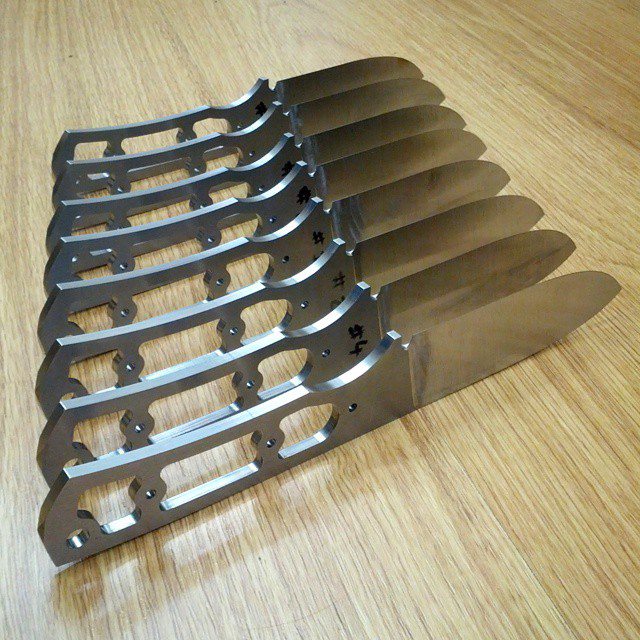
Thanks to the fact that I had already removed the bulk of the material on the mill, the grinding went very quickly! I used a 120 grit blaze belt and it still feels fresh after grinding all 8 of these blades, which is nice! I used to burn through a lot of belts!
These blades are all getting coated with Cerakote, so there's no need to go to a higher grit finish than this as they'll soon be sandblasted in preparation for spraying!
Pleased with how they've come out! Today I will be working on tuning up the toolpaths used for making the handle scales!
Thanks to the fact that I had already removed the bulk of the material on the mill, the grinding went very quickly! I used a 120 grit blaze belt and it still feels fresh after grinding all 8 of these blades, which is nice! I used to burn through a lot of belts!
These blades are all getting coated with Cerakote, so there's no need to go to a higher grit finish than this as they'll soon be sandblasted in preparation for spraying!
Pleased with how they've come out! Today I will be working on tuning up the toolpaths used for making the handle scales!

- Joined
- May 8, 2014
- Messages
- 120
Enjoying following your progress.
I'd never heard of maritool before you mentioned it. Their prices look good. Have you been happy with their quality?
I'd never heard of maritool before you mentioned it. Their prices look good. Have you been happy with their quality?

Nathan the Machinist
KnifeMaker / Machinist / Evil Genius
Moderator
Knifemaker / Craftsman / Service Provider
- Joined
- Feb 13, 2007
- Messages
- 18,964
Enjoying following your progress.
I'd never heard of maritool before you mentioned it. Their prices look good. Have you been happy with their quality?
^
I know nobody asked me, but considering I've purchased tens of thousands of dollars in tooling over the years I'd like to put in my two cents on this one.
I regret all the high end Jacobs super precision and Albrecht drill chucks I've bought over the years and crappy Kennametal tool holders etc. Once I found Maritool I've never looked back. The quality is what it needs to be and the price is excellent. In my tests, their endmills don't perform as well as Lakeshore Carbide, but they're pretty good, particularly the thread mills and Vmills. But their tool holders is where they shine. Sidelock, facemills, adapters, ER collet chucks, drill chucks etc, they're all very good for most uses.
- Joined
- Mar 12, 2013
- Messages
- 1,167
Enjoying following your progress.
I'd never heard of maritool before you mentioned it. Their prices look good. Have you been happy with their quality?
So far they've been a pleasure to deal with and everything I've bought has been very high quality! The prices are amazing too, if I was to but import toolholders from a canadian supplier I'd be looking at around $250 for a CAT40 ER24 collet holder... I can buy a USA made toolholder from Maritool for about CAD$130 including shipping and so on. Their toolholder are absolutely beautiful, some of the nicest machining and grinding I've seen on anything.
I was also just hugely impressed that Frank (the owner) was willing to add an entire product line essentially just because I said I needed it. Pretty amazing service!
I know nobody asked me, but considering I've purchased tens of thousands of dollars in tooling over the years I'd like to put in my two cents on this one.
I regret all the high end Jacobs super precision and Albrecht drill chucks I've bought over the years and crappy Kennametal tool holders etc. Once I found Maritool I've never looked back. The quality is what it needs to be and the price is excellent. In my tests, their endmills don't perform as well as Lakeshore Carbide, but they're pretty good, particularly the thread mills and Vmills. But their tool holders is where they shine. Sidelock, facemills, adapters, ER collet chucks, drill chucks etc, they're all very good for most uses.
My experience mirrors yours, although I can't comment on tool life as I have nothing to compare to!
Your input is always welcomed Nathan, you know your stuff and I'm sure we all welcome that experience, I certainly do!
- Joined
- Mar 12, 2013
- Messages
- 1,167
Sorry it's been a while since the last update!
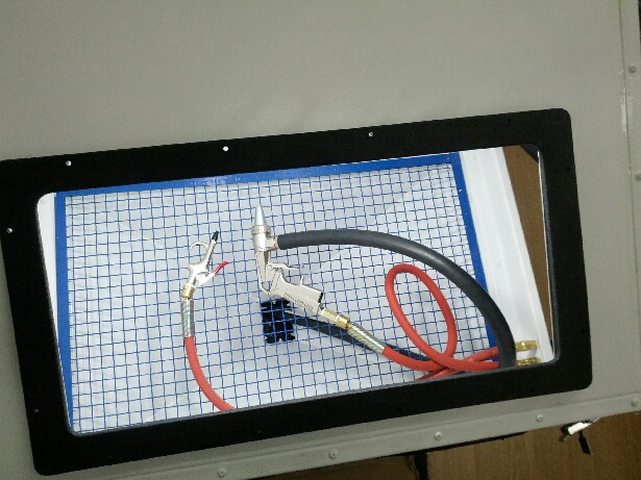
I've spent quite a lot of time over the last little while making new equipment. Been working on a custom sandblasting cabinet that should make prepping for Cerakote much more pleasant! It has 3000 lumens of LED lighting in it, a nice blasting gun and also a blow-off nozzle in there. The inside is lined with white plastic to make it easier to see everything (and the plastic won't wear away like paint would). The glass window will be protected by a very fine stainless steel mesh rather than the usual peel off plastic... Apparently they use the mesh method on some high-end cabinets and it's supposed to practically last forever, we'll see how it works out!
Here's a view inside the cabinet as it stands at the moment, still have to add the window and mesh:
I also built a small PID controlled oven to cure the Cerakote in, basically just a toaster oven retrofitted with a PID controller and a solid state relay:
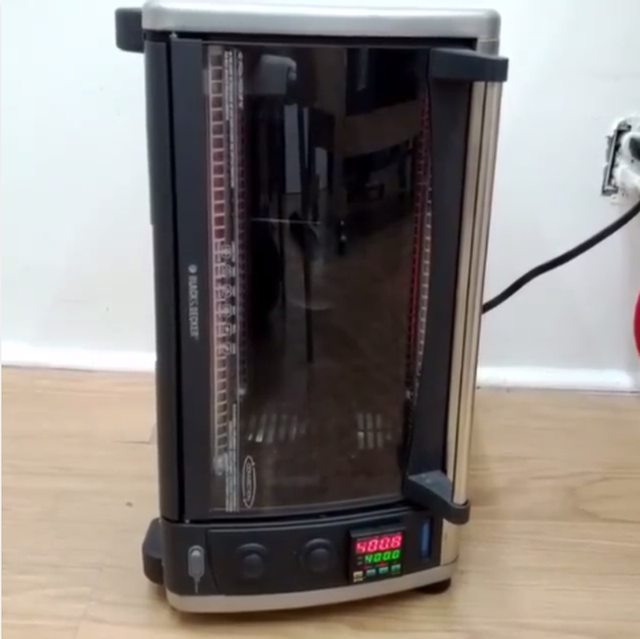
I was hoping to be able to use it for tempering as well, but I don't think that will work out. This oven is a little small for the job, but it will do for the moment. I will scratch-build a larger oven once I'm up and running.
As of Thursday I have officially started my first production run! Pretty exciting! I'm doing 24 knives in the first batch. Here you can see the first stage:
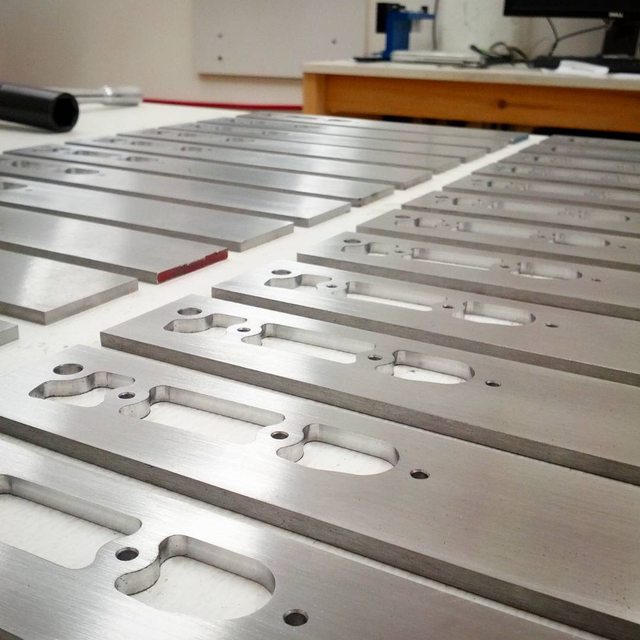
After that step they are placed into the fixtures for operations 2 and 3: profiling the blade, and then roughing out the bevels:
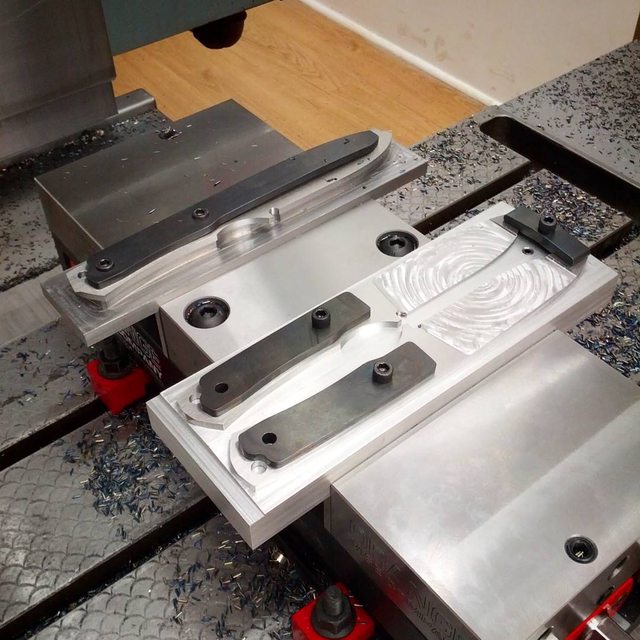
After the bevels are roughed out they're finished by hand on the belt grinder. Doing operations 2 and 3 in one go gives me enough time to do the grinding while the machine is finishing the next knife, works out very well!
The profiling operation turned out to be the trickiest one so far. Basically because I'm machining a thin material that's not ideally supported. To help this I had some custom tools made. These are 'downcut' endmills (left hand spiral, right hand cut) which push the material down onto the fixture rather than pulling it up. Before the chatter (material movement) was destroying the cutting edges on the tools very quickly, I was only getting 3-4 blades from one tool!
The length of tool I ordered ended up being too long so I had to cut them down to just 0.4" of flute:
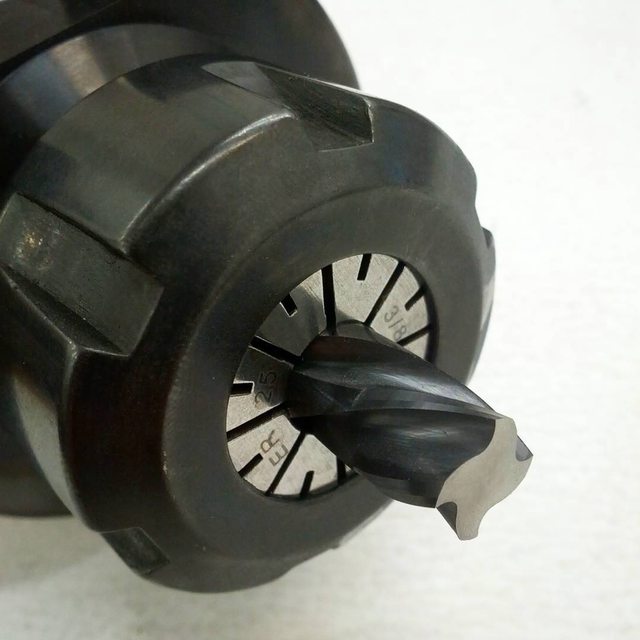
(EDIT: tool is further in the collet than would usually be wise here, I had to really shorten up on it to combat chatter. Seems to be working ok so far!)
Did this with a dremel and a diamond cutoff wheel, bit finicky but worked very well!
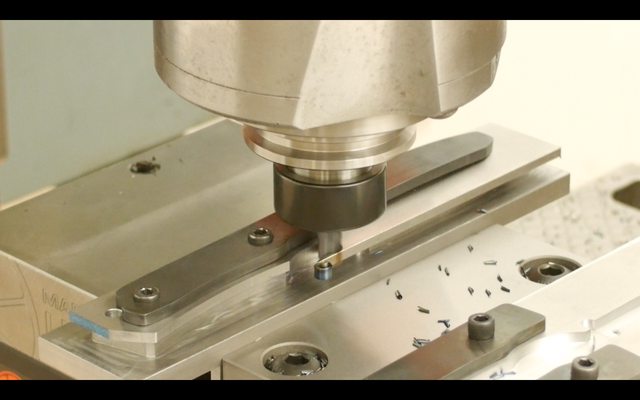
Using those new tools in combination with a new toolpath seems to be working very well. Before I was cutting at the edge of the material and working my way inward (high speed machining) which was destroying tools because the edges of the thin material was moving up and down and chipping the tools. Now I'm just digging right in and tracing the outline of the knife in a 'slotting' operation. This ensures that I'm always cutting the material where it has the most support. I've already cut 10 blades with the new tool and it still looks brand new! I'm hoping tool life should be more like 50-100 blades per tool now (at the least!).
Here you can see the profiling operation in progress:
I've been taking hours and hours of video footage throughout all this process, hopefully I should be able to turn it into several videos. I'd like to cover the final production process in one video, then have another video that shows the development of the process. I also have some footage for a 'fails' video with destroyed tooling and sparks aplenty!
I've spent quite a lot of time over the last little while making new equipment. Been working on a custom sandblasting cabinet that should make prepping for Cerakote much more pleasant! It has 3000 lumens of LED lighting in it, a nice blasting gun and also a blow-off nozzle in there. The inside is lined with white plastic to make it easier to see everything (and the plastic won't wear away like paint would). The glass window will be protected by a very fine stainless steel mesh rather than the usual peel off plastic... Apparently they use the mesh method on some high-end cabinets and it's supposed to practically last forever, we'll see how it works out!
Here's a view inside the cabinet as it stands at the moment, still have to add the window and mesh:
I also built a small PID controlled oven to cure the Cerakote in, basically just a toaster oven retrofitted with a PID controller and a solid state relay:
I was hoping to be able to use it for tempering as well, but I don't think that will work out. This oven is a little small for the job, but it will do for the moment. I will scratch-build a larger oven once I'm up and running.
As of Thursday I have officially started my first production run! Pretty exciting! I'm doing 24 knives in the first batch. Here you can see the first stage:
After that step they are placed into the fixtures for operations 2 and 3: profiling the blade, and then roughing out the bevels:
After the bevels are roughed out they're finished by hand on the belt grinder. Doing operations 2 and 3 in one go gives me enough time to do the grinding while the machine is finishing the next knife, works out very well!
The profiling operation turned out to be the trickiest one so far. Basically because I'm machining a thin material that's not ideally supported. To help this I had some custom tools made. These are 'downcut' endmills (left hand spiral, right hand cut) which push the material down onto the fixture rather than pulling it up. Before the chatter (material movement) was destroying the cutting edges on the tools very quickly, I was only getting 3-4 blades from one tool!
The length of tool I ordered ended up being too long so I had to cut them down to just 0.4" of flute:
(EDIT: tool is further in the collet than would usually be wise here, I had to really shorten up on it to combat chatter. Seems to be working ok so far!)
Did this with a dremel and a diamond cutoff wheel, bit finicky but worked very well!
Using those new tools in combination with a new toolpath seems to be working very well. Before I was cutting at the edge of the material and working my way inward (high speed machining) which was destroying tools because the edges of the thin material was moving up and down and chipping the tools. Now I'm just digging right in and tracing the outline of the knife in a 'slotting' operation. This ensures that I'm always cutting the material where it has the most support. I've already cut 10 blades with the new tool and it still looks brand new! I'm hoping tool life should be more like 50-100 blades per tool now (at the least!).
Here you can see the profiling operation in progress:
I've been taking hours and hours of video footage throughout all this process, hopefully I should be able to turn it into several videos. I'd like to cover the final production process in one video, then have another video that shows the development of the process. I also have some footage for a 'fails' video with destroyed tooling and sparks aplenty!
Last edited:
- Joined
- Mar 12, 2013
- Messages
- 1,167
Well the first production batch is now rough ground and heat-treated. Today I'll be working on finish grinding them to 180 grit. Normally I don't grind after heat-treat, but the 120 grit turned out to be too coarse for the Cerakote, grinding marks are still showing up through the finish. I bought a bunch of 180/220 grit Aluminum Oxide belts that I can run wet for the finish grinding so as to avoid any temper issues.
The prototype batch has been sandblasted and sprayed with Graphite Black Cerakote at an 18:1 ratio. The HVLP gun was set to a very low airflow and a 3" wide fan pattern at about 6" distance. The new Iwata gun I bought from Cerakote is beautiful and very easy to setup and spray with!
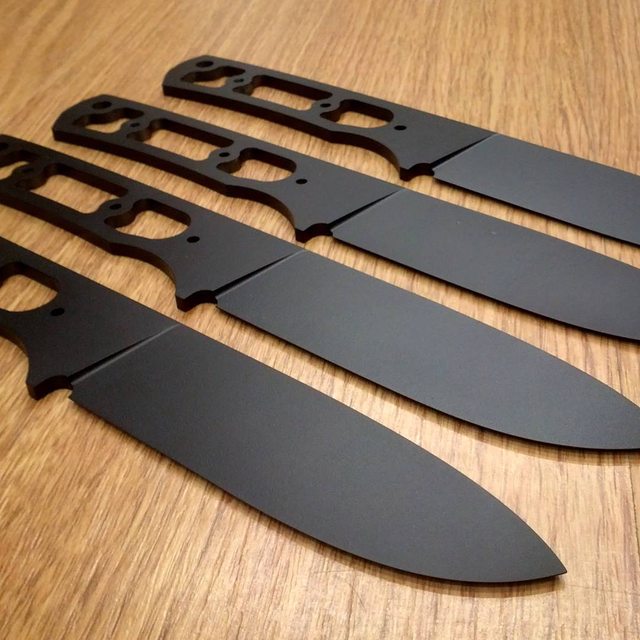
Sandblasting the blades in in credibly tiring, I'm going to be modifying my blasting gun so that it's attached to the cabinet and always on, that way I can manipulate the blades with both hands in front of the gun, rather than having to manipulate both the gun and the blades... Should make life much easier!
Today I'll be doing finish grinding and handle laminations, and probably starting on Cerakote. Tomorrow I will hopefully be finishing the Cerkote, then Saturday I'll be machining handle scales!
Going a bit slower than I'd like, but still making progress!
The prototype batch has been sandblasted and sprayed with Graphite Black Cerakote at an 18:1 ratio. The HVLP gun was set to a very low airflow and a 3" wide fan pattern at about 6" distance. The new Iwata gun I bought from Cerakote is beautiful and very easy to setup and spray with!
Sandblasting the blades in in credibly tiring, I'm going to be modifying my blasting gun so that it's attached to the cabinet and always on, that way I can manipulate the blades with both hands in front of the gun, rather than having to manipulate both the gun and the blades... Should make life much easier!
Today I'll be doing finish grinding and handle laminations, and probably starting on Cerakote. Tomorrow I will hopefully be finishing the Cerkote, then Saturday I'll be machining handle scales!
Going a bit slower than I'd like, but still making progress!
- Joined
- Jan 14, 2015
- Messages
- 1,312
thanks for the update, i always enjoy your work and wip.
- Joined
- Mar 12, 2013
- Messages
- 1,167
thanks for the update, i always enjoy your work and wip.
No worries mate, thanks for following along!
^
I know nobody asked me, but considering I've purchased tens of thousands of dollars in tooling over the years I'd like to put in my two cents on this one.
I regret all the high end Jacobs super precision and Albrecht drill chucks I've bought over the years and crappy Kennametal tool holders etc. Once I found Maritool I've never looked back. The quality is what it needs to be and the price is excellent. In my tests, their endmills don't perform as well as Lakeshore Carbide, but they're pretty good, particularly the thread mills and Vmills. But their tool holders is where they shine. Sidelock, facemills, adapters, ER collet chucks, drill chucks etc, they're all very good for most uses.
Nathan, I'm curious what you don't like about Kennametal? It's our primarily lathe tooling and we also have tens of thousands of dollars into these holders
I don't think we have any Maritool and I've not heard of them.


For the mills we use primarily Valenite and Iscar
but of course every shop is different.

Nathan the Machinist
KnifeMaker / Machinist / Evil Genius
Moderator
Knifemaker / Craftsman / Service Provider
- Joined
- Feb 13, 2007
- Messages
- 18,964
^ Mediocre cost to performance ratio in endmill setscrew holders and collet chucks, inserts and cutters in general.
I was talking about milling in particular, though I haven't been real impressed with the Kennametal lathe tooling I have either, though it isn't a subject I know a great deal about.
I was talking about milling in particular, though I haven't been real impressed with the Kennametal lathe tooling I have either, though it isn't a subject I know a great deal about.
aarongough: I just found this thread - thanks for posting your thread. I've been playing around with a tiny desktop CNC and have a LOTS of fun with it. Of course, it's way too small for much in the way of knife work.
You're doing a GREAT job and good luck with your business.
Ken H>
You're doing a GREAT job and good luck with your business.
Ken H>
- Joined
- Mar 12, 2013
- Messages
- 1,167
aarongough: I just found this thread - thanks for posting your thread. I've been playing around with a tiny desktop CNC and have a LOTS of fun with it. Of course, it's way too small for much in the way of knife work.
You're doing a GREAT job and good luck with your business.
Ken H>
Thanks Ken! The CNC stuff is fun, really different to doing everything by hand, but in a good way for me at least... I like designing processes rather than having to do constant repetitive work!
- Joined
- Mar 12, 2013
- Messages
- 1,167
So yesterday I finally got the production batch of blades all coated with Cerakote!
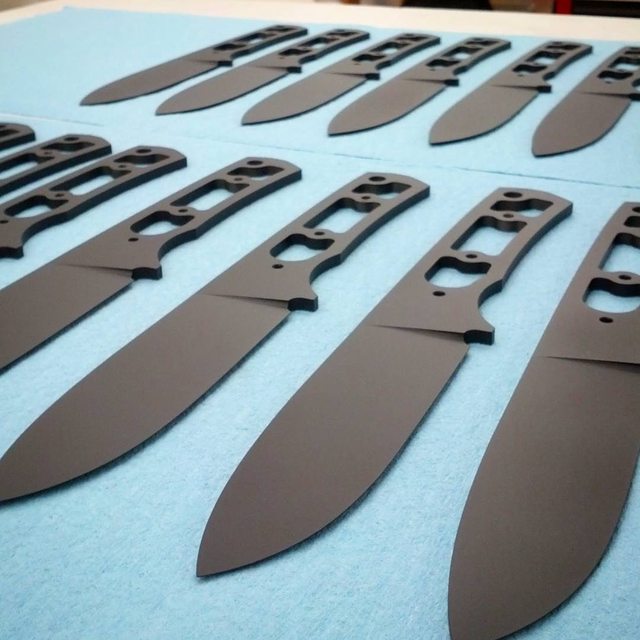
Cerakote really is quite tricky to apply right, requires that everything happens just perfectly. This was actually the second time I coated these blades, the first time the spray gun settings weren't perfect and I ended up with a lot of orange peel.
This time the coating is probably the nicest I've ever done. Zero texture, zero orange-peel... It really doesn't look like paint at all, looks more like a PVD coating like DLC than anything else as it doesn't have any discernible thickness!
Today I'll be working on setting up a system for doing the engraving on the blades using the VMC. Then I'll be doing the stock prep for the handle scales.
The big upcoming challenge is making the sheaths! I want to use a vacuum forming system on the VMC and have it cut the sheath parts out from the sheet once they're formed. I've never made a mold before though, so it should be a fun process!
Cerakote really is quite tricky to apply right, requires that everything happens just perfectly. This was actually the second time I coated these blades, the first time the spray gun settings weren't perfect and I ended up with a lot of orange peel.
This time the coating is probably the nicest I've ever done. Zero texture, zero orange-peel... It really doesn't look like paint at all, looks more like a PVD coating like DLC than anything else as it doesn't have any discernible thickness!
Today I'll be working on setting up a system for doing the engraving on the blades using the VMC. Then I'll be doing the stock prep for the handle scales.
The big upcoming challenge is making the sheaths! I want to use a vacuum forming system on the VMC and have it cut the sheath parts out from the sheet once they're formed. I've never made a mold before though, so it should be a fun process!
Nathan the Machinist
KnifeMaker / Machinist / Evil Genius
Moderator
Knifemaker / Craftsman / Service Provider
- Joined
- Feb 13, 2007
- Messages
- 18,964
^FYI, mold shrinkage for Kydex is about .006 in/in
- Joined
- Mar 12, 2013
- Messages
- 1,167
^FYI, mold shrinkage for Kydex is about .006 in/in
Hey mate!
Is that for vacuum forming or injection? How does shrinkage affect the part when vacuum forming, I must admit I hadn't even thought of that as an issue, will be fun learning this
