WIP: Designing and building the new Resolute with the help of CNC.

Hey guys!
Sorry it's been a while since the last update! As some of you may have heard I left my day job last week to go full-time with knifemaking! Pretty excited about that! Working now to get my process ironed out, once it's mostly sorted I will be doing a few batches of knives one after the other!

I did some more work on the machining center the other day, the thrust bearings on the X & Y axes had gone bad. The original bearings were still in there and were mostly rust, once I replaced them some issues I'd been having with chatter magically disappeared :)

After that I got stuck into sourcing my materials and working on optimized toolpaths for the different parts of the new Resolute!

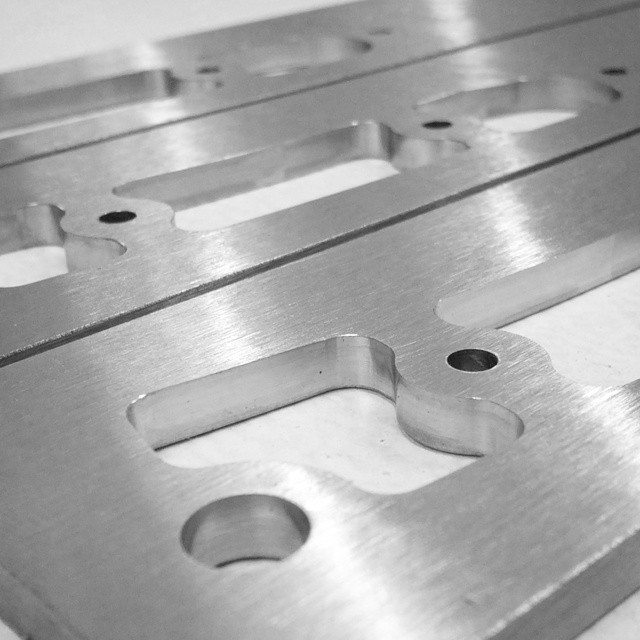
First step was to redo the toolpath for cutting the interior features of the tang. The pin holes are now drilled and then reamed to 0.1235" so I can get a much closer fit with my handle pins and help make sure my scales line up perfectly. I'm also now deburring the front and back of the part all on the machine! The tool that reaches through the pin holes to deburr the backside of the holes is only 0.098" in diameter! Seems to be working very well so far, the tangs come off the machine looking like this:

aIM4zRwl.jpg


One thing that I'm focusing on is getting my tang size and position relative to my handle scale outline as close as possible. With our fingers we can feel a mismatch as small as 0.0005" (half a thousandth!) so the parts need to be exactly on size, and the pin holes need to be in exactly the right locations.

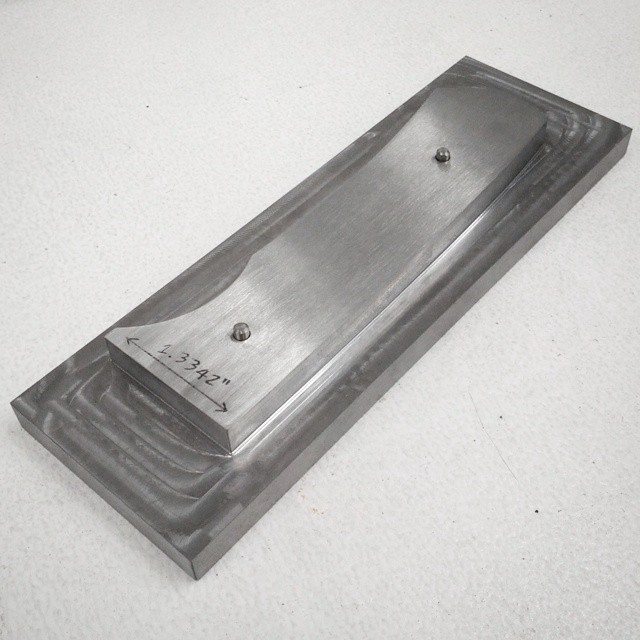
To help verify my tangs and scales in a quick and easy qualitative fashion I made a 'master' of the Resolute MKIII handle. I spent a bunch of time dialling it in to exactly the right size within 0.0001" so that I can use it to compare against the parts I make:

EC19nZil.jpg


Because it has locating pins on it I can drop a tang or a handle scale on top and then very quickly feel with my fingertips whether it's undersize or oversize and also verify the position of the pin holes... This is not the sort of thing that would fly in an aerospace machine shop, but I think it will work very well for what I'm doing!

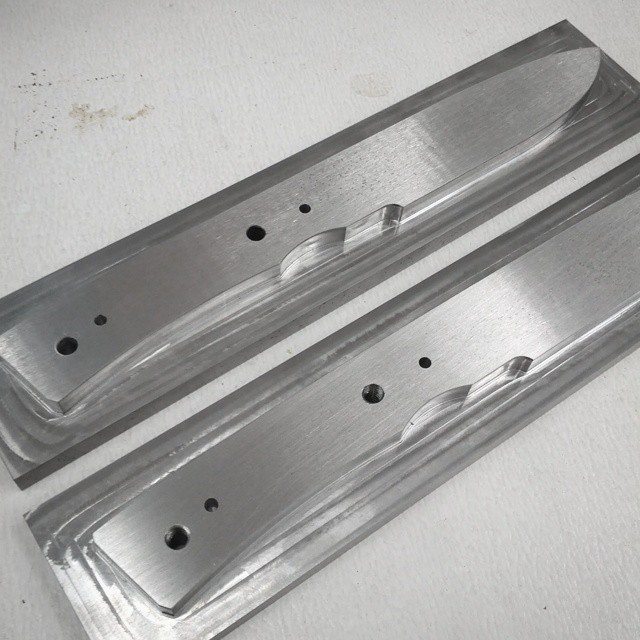
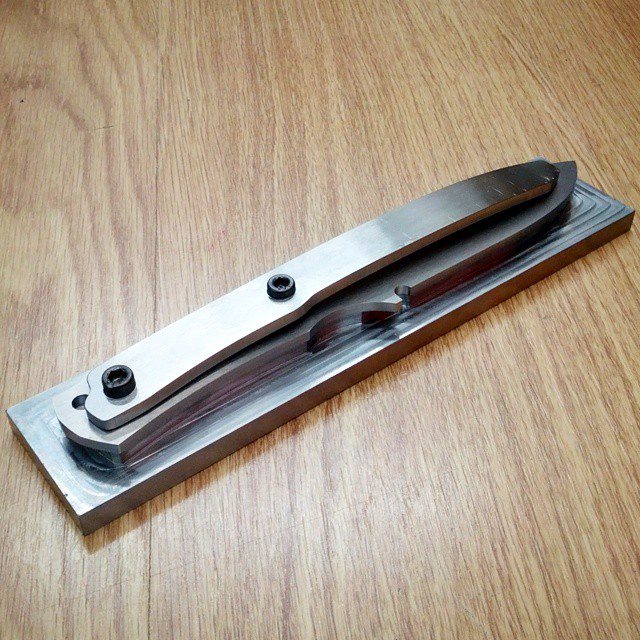
I also needed to make a new version of my second operation fixture for machining the periphery of the blade blanks:

3d9gsRjl.jpg


These were designed with cutaway areas at the butt and at the choil so that I can get underneath the blank to cut the window-breaker chamfers and a chamfer just behind the choil. The position of the top left corner of these fixtures in relation to the pins is absolutely critical on this fixture as it defines how closely the blade outline will be matched up with the pin holes. The two you see in the photo were both rejects unfortunately, I got it right the third time though!

In the future I would like to develop a fixture that lets me machine the periphery and the pin holes in the same setup, that way I eliminate a step that introduces error!

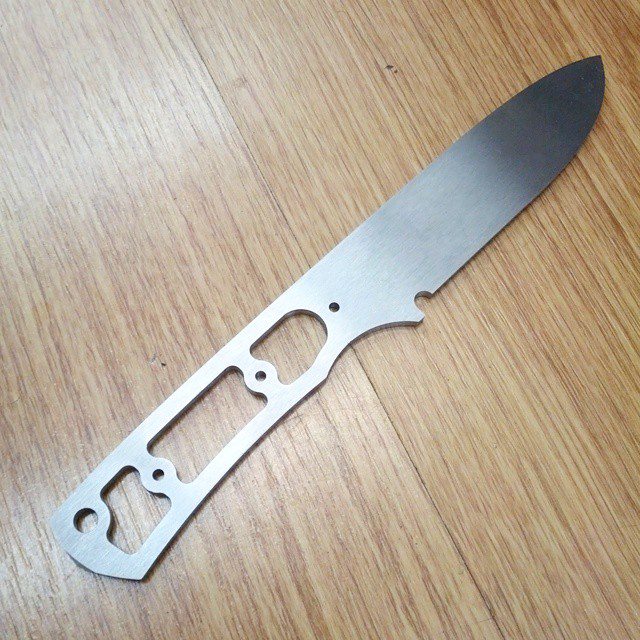
All of that work led to this:

upkdotwl.jpg


This is a blade that's exactly on size, deburred front and back and already has the windowbreaker cut. Total machine time for this blank was a little under 11 minutes!

I need to work out a better way of hanging onto the blade while machining the periphery though, at the moment the stock near the tip is chattering and totally killing my tool life. I'm trying to find a source 'downcut' endmills so I can push the part down onto the fixture while cutting instead of pulling it up, I think that should solve the majority of the issue. I'm also contemplating building a small vacuum clamp into the fixture underneath the blade, those two things combined should hopefully let me run my tools a lot harder while also hugely increasing tool life!

Lots of work still to go, but so far I'm having a lot of fun and learning a lot!

-Aaron
 
Aaron I know you are going pretty much automated now, but if there was a .0005 difference between your scale and tang wouldn't sandpaper do the trick?

It looks like you're not doing handmade knives anymore, and maybe that's the point here... But, maybe you shouldn't take the handmade component completely out of your knives. Jmo.
 
Hey guys!
Sorry it's been a while since the last update! As some of you may have heard I left my day job last week to go full-time with knifemaking! Pretty excited about that! Working now to get my process ironed out, once it's mostly sorted I will be doing a few batches of knives one after the other!

I did some more work on the machining center the other day, the thrust bearings on the X & Y axes had gone bad. The original bearings were still in there and were mostly rust, once I replaced them some issues I'd been having with chatter magically disappeared :)

After that I got stuck into sourcing my materials and working on optimized toolpaths for the different parts of the new Resolute!

First step was to redo the toolpath for cutting the interior features of the tang. The pin holes are now drilled and then reamed to 0.1235" so I can get a much closer fit with my handle pins and help make sure my scales line up perfectly. I'm also now deburring the front and back of the part all on the machine! The tool that reaches through the pin holes to deburr the backside of the holes is only 0.098" in diameter! Seems to be working very well so far, the tangs come off the machine looking like this:

aIM4zRwl.jpg


One thing that I'm focusing on is getting my tang size and position relative to my handle scale outline as close as possible. With our fingers we can feel a mismatch as small as 0.0005" (half a thousandth!) so the parts need to be exactly on size, and the pin holes need to be in exactly the right locations.

To help verify my tangs and scales in a quick and easy qualitative fashion I made a 'master' of the Resolute MKIII handle. I spent a bunch of time dialling it in to exactly the right size within 0.0001" so that I can use it to compare against the parts I make:

EC19nZil.jpg


Because it has locating pins on it I can drop a tang or a handle scale on top and then very quickly feel with my fingertips whether it's undersize or oversize and also verify the position of the pin holes... This is not the sort of thing that would fly in an aerospace machine shop, but I think it will work very well for what I'm doing!

I also needed to make a new version of my second operation fixture for machining the periphery of the blade blanks:

3d9gsRjl.jpg


These were designed with cutaway areas at the butt and at the choil so that I can get underneath the blank to cut the window-breaker chamfers and a chamfer just behind the choil. The position of the top left corner of these fixtures in relation to the pins is absolutely critical on this fixture as it defines how closely the blade outline will be matched up with the pin holes. The two you see in the photo were both rejects unfortunately, I got it right the third time though!

In the future I would like to develop a fixture that lets me machine the periphery and the pin holes in the same setup, that way I eliminate a step that introduces error!

All of that work led to this:

upkdotwl.jpg


This is a blade that's exactly on size, deburred front and back and already has the windowbreaker cut. Total machine time for this blank was a little under 11 minutes!

I need to work out a better way of hanging onto the blade while machining the periphery though, at the moment the stock near the tip is chattering and totally killing my tool life. I'm trying to find a source 'downcut' endmills so I can push the part down onto the fixture while cutting instead of pulling it up, I think that should solve the majority of the issue. I'm also contemplating building a small vacuum clamp into the fixture underneath the blade, those two things combined should hopefully let me run my tools a lot harder while also hugely increasing tool life!

Lots of work still to go, but so far I'm having a lot of fun and learning a lot!

-Aaron

Aaron, excellent work so far.

If I were having the same problem with tip chatter, and wanted to solve it without impeding the tool path or completely remaking the fixture, there are two ways I might attack it.

My first attempt would be to add an extension bar in the shape of the blade but a bit smaller, to the top section of the fixture, thick enough to be significantly rigid, but not too thick to interfere with the toolholder you are using.

You could either attach it to the fixture, or just make it as a big, funny shaped "washer" that just goes on over the top section and gets held down with the same screws.

Preferably it would be spring hardened steel. It would have a hole drilled in the end to attach a tensioning spacer between it and the blade.

I'd make the spacer round nosed and about .100" too thick to start, then cut it down a bit if the extension bar was applying too much pressure.

If you were to use something like 1/4" stock @ spring hard, and put in about .075" of tension with the spacer, give or take, it would probably apply a couple hundred pounds or so of pressure, as a wild guess.

If that wasn't enough, I'd make a cantilever clamp with a hole in the center, and threaded hole for large set screw on the end opposite the tip. Once again you could make an adjustable length spacer as above

You could also machine a single piece top clamp that would do the same job, would look cleaner, but I don't know if I would go to the trouble since most of my experience is as a prototype machinist and I can tend to be fast and loose with my fixturing.

If the tension required for appropriate clamping pressure at the tip was enough to put undue stress on the top section screws, you could heli-coil those holes.


Sorry for the double spacing haha, thought it might be less of a mess to read considering I was trying to go from 3D mental image to text. I'm sure there are at least 5 better ways to do it than mine, but at worst it might give you some ideas. I've done a similar thing as I suggested above on similar parts and had great success.

Edit: I nerded out, the pressure required to deflect a 1"w x .25" thick x 8" long spring, by 1" in the middle, is something in the order of 2500+lbs. I'd expect with a minimal deflection you could get into the hundreds of pounds of clamping pressure pretty easily. I don't believe it is linear so it will be softer at lower deflections, plus it will in effect be a tapered spring because of the shape of the blade.
 
Last edited:
Aaron I know you are going pretty much automated now, but if there was a .0005 difference between your scale and tang wouldn't sandpaper do the trick?

It looks like you're not doing handmade knives anymore, and maybe that's the point here... But, maybe you shouldn't take the handmade component completely out of your knives. Jmo.

Hey Shane!
I'm definitely not describing my knives as handmade any more, and that's fine with me. My goal is to make some of the best working knives available and I want to use methods that I find fun! Automation is like catnip for me so that's where I'm headed! For the time being I'll still be doing a lot of stuff by hand though to be honest, sandblasting, spraying Cerakote, deburring, and some bevel grinding as well. I really like the consistency I can get from machining everything though so I'm trying to do that when I can.

In regards to tuning the size by hand: I'm trying not to do that as I really want to bake all the consistency I can right into the process. However in the end I will do what I need to do to get everything perfect, especially while I'm still gearing up and learning!
 
Aaron, excellent work so far.

If I were having the same problem with tip chatter, and wanted to solve it without impeding the tool path or completely remaking the fixture, there are two ways I might attack it.

My first attempt would be to add an extension bar in the shape of the blade but a bit smaller, to the top section of the fixture, thick enough to be significantly rigid, but not too thick to interfere with the toolholder you are using.

You could either attach it to the fixture, or just make it as a big, funny shaped "washer" that just goes on over the top section and gets held down with the same screws.

Preferably it would be spring hardened steel. It would have a hole drilled in the end to attach a tensioning spacer between it and the blade.

I'd make the spacer round nosed and about .100" too thick to start, then cut it down a bit if the extension bar was applying too much pressure.

If you were to use something like 1/4" stock @ spring hard, and put in about .075" of tension with the spacer, give or take, it would probably apply a couple hundred pounds or so of pressure, as a wild guess.

If that wasn't enough, I'd make a cantilever clamp with a hole in the center, and threaded hole for large set screw on the end opposite the tip. Once again you could make an adjustable length spacer as above

You could also machine a single piece top clamp that would do the same job, would look cleaner, but I don't know if I would go to the trouble since most of my experience is as a prototype machinist and I can tend to be fast and loose with my fixturing.

If the tension required for appropriate clamping pressure at the tip was enough to put undue stress on the top section screws, you could heli-coil those holes.


Sorry for the double spacing haha, thought it might be less of a mess to read considering I was trying to go from 3D mental image to text. I'm sure there are at least 5 better ways to do it than mine, but at worst it might give you some ideas. I've done a similar thing as I suggested above on similar parts and had great success.

Edit: I nerded out, the pressure required to deflect a 1"w x .25" thick x 8" long spring, by 1" in the middle, is something in the order of 2500+lbs. I'd expect with a minimal deflection you could get into the hundreds of pounds of clamping pressure pretty easily. I don't believe it is linear so it will be softer at lower deflections, plus it will in effect be a tapered spring because of the shape of the blade.

Hey Ian!
Thanks for the feedback mate, that's invaluable!

You did actually raise a couple of points I hadn't thought of!

My current clamp does have a little spring 'finger' however I made it from low carbon stock... The first few times I used it I had much less chatter than I'm seeing now. I thought it was because I had adjusted my speeds/feeds but I think it may actually be because that spring has lost at least some of it's bend. I will have to check that when I get to the shop. That might need to be replaced with a longer one made from hardened steel as you suggested!

I think I may also have found a source for the 'downcut' endmills I was looking for. Those in combination with a better spring clamp could be just the ticket I think!
 
This takes a whole different skill set Aaron, and I applaud you for taking it on. This is so far from your custom filing jig from only a few years ago!

There is obviously room for all of us in the knife manufacturing world and it looks like you are finding a new niche for yourself.
 
Ian, I took your advice mate! Made a new clamping caul for the fixture today:

jpq1Sp3l.jpg


I bent the spring 'finger' about 0.4" or so, then hardened it to about 55HRC. It exerts a LOT more force than the previous clamp did. With the old clamp if I pried underneath the stock with a screwdriver it was very easy to move it... Not so much with the new one! You have to really crank on it to get it to move! Thanks for the good idea!

Probably the weakest point now is halfway in between the point where the finger makes contact and the frontmost bolt. We'll see how it works out tomorrow morning!
 
Nice! That thing looks beefy.

Makes me miss the shop, fixturing can be a huge pain but it can also be really fun when you finally solve a problem.
 
Fusion outputs non-engagement point-to-point moves as G1 most of the time because the Fadal does not do synchronized G0 moves (it will dog-leg instead)...

This is where I decided to stop reading and just enjoy the pictures. ;)

Good stuff Aaron, thanks for sharing.
 
Nice! That thing looks beefy.

Makes me miss the shop, fixturing can be a huge pain but it can also be really fun when you finally solve a problem.

Yeah I totally hear you on the 'huge pain' part :) I'm slowly getting the hang of it, definitely busted a few more tools so far than I should have, some of them fairly spectacularly!

Today I'm working on a fixture that will hopefully let me partially mill my bevels. I want to be able to cut the plunge line and the straight portion of the bevel on the machine to help get that area looking consistent all the time. Not quite sure if the setup will be sturdy enough, we'll see how it goes!
 
Patrice Lemée;14908951 said:
This is where I decided to stop reading and just enjoy the pictures. ;)

Good stuff Aaron, thanks for sharing.

Hey Patrice! I promise most of it won't be that obscure!

No worries mate, thanks for following along!
 
Ian, I took your advice mate! Made a new clamping caul for the fixture today:

jpq1Sp3l.jpg


I bent the spring 'finger' about 0.4" or so, then hardened it to about 55HRC. It exerts a LOT more force than the previous clamp did. With the old clamp if I pried underneath the stock with a screwdriver it was very easy to move it... Not so much with the new one! You have to really crank on it to get it to move! Thanks for the good idea!

Probably the weakest point now is halfway in between the point where the finger makes contact and the frontmost bolt. We'll see how it works out tomorrow morning!
Aaron, make two fingers. One short that is the first layer and touches halfway between the front screw and the tip. The second is long enough to reach the tip and is curved up to get around the first finger then down to touch the tip. It would look funky, but I bet it would be secure!
 
Aaron, make two fingers. One short that is the first layer and touches halfway between the front screw and the tip. The second is long enough to reach the tip and is curved up to get around the first finger then down to touch the tip. It would look funky, but I bet it would be secure!

I think that would work quite well Brian!

I'm hoping to avoid the whole issue with the help of some new tooling. I've got some endmills on the way that are 'downcut' endmills... Rather than a spiral that pulls the material up, the spiral is reversed so it pushes the material down onto the fixture. Hopefully those should let me run a lot harder!

Those endmills are a special item and as far as I can tell there aren't any companies that make them as a stock item, I'm talking with a manufacturer at the moment who will hopefully be able to add them as a stock item so they're more accessible!
 
....or you could try a wooden wedge between the 2 bolts, just close to the central one. It may add a little more pressure in the central zone. Or a cutoff piece of valve spring, but the wood will damp the chatter better probably
 
Back
Top