Nathan the Machinist
KnifeMaker / Machinist / Evil Genius
Moderator
Knifemaker / Craftsman / Service Provider
- Joined
- Feb 13, 2007
- Messages
- 18,964
Hey mate!
Is that for vacuum forming or injection? How does shrinkage affect the part when vacuum forming, I must admit I hadn't even thought of that as an issue, will be fun learning this
The values are very similar. I believe it is a function of the coefficient of thermal expansion and the glass transition temperature of the material and not the process used to process it. It's also not written in stone, shrinking in an injection molded part can be reduced with increased packing pressure and lots of things can affect it with thermoforming too, particularly how long you let it sit on the mold, if it's a male or female mold, textures and details, sheet and mold temperatures etc. so .006 is a rule but it could be +-.003.
The other thing with thermoforming is the Z axis often shrinks more than the X and Y because there is material spring back as well as plastic shrinkage, particularly in an amorphous material like Kydex. This can be affected by how quickly the part cools and which side (tool side or outside) cools fastest.
This makes it sound hopelessly complicated. It's not, you'll get it. Just don't be discouraged when it doesn't work perfect the first time.
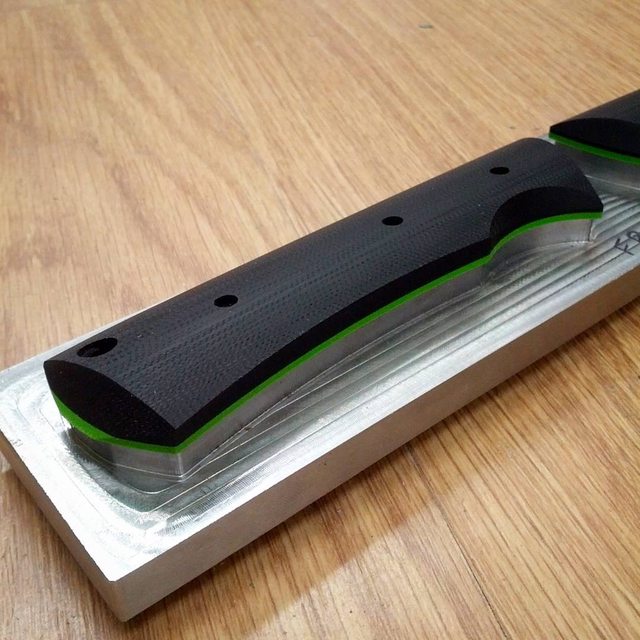
Sometimes second op fixtures are cast (bondo etc) from a molded part rather than machined from a file because it's hopeless to get all the weirdness compensated perfectly.
Also, sometimes you want somthing to shrink a little. Kydex sheath makers aren't really compensating for this, they might build up a little thickness on the blade or the scales etc to get the fit they want and I'll bet most of them are not aware their sheaths are a little smaller than their knife, and they probably wouldn't work right if they weren't.
Just remember, it's pretty typical for a 12" dimension on the mold to be about 1/16" shorter on the finished part.