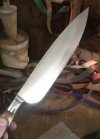
Would 1/4" thick 10" blade be stronger of forged vs stock removal?

Bodog, quite true there is no conclusive evidence that stock removal is better. Conversely, there is no evidence that forged is better either. The very same guys who blacksmith a blade know that forged is not better. The few that I have talked to have told me that they enjoy the forge and learning how metals react under the hammer. It isn't so much about better performance. Todays HT protocols are so good and todays rolled steel stock is so good that forging is a hobby to be passed down.

I have a Scrapyard SR101 9 inch blade(911). It is basically 52100 differentially heat treated stock removal blade with an Rc of 60. It is 1/4 inch thick and it cost around $200. I bet there are hundreds if not thousands of forged 52100 blades out there to compare it to if someone wanted to. Yet no comparisons. Swamp Rat makes the same one but with micarta handles. There are plenty of both knives available. Easy enough to do a comparison and the people who own these knives actually use them. So if you wish to compare I would bet there is someone near you that has one on this forum. But here is what you are up against(video below). If you live near me I would be more than happy to compare mine to your forged 52100 blade if you have one. I also have a small stock removal cpm3v blade that I would compare to a small forged blade. I know there are a few guys who have tried to forge 3V, lol.

[video=youtube;B4NEkK-ehdo]https://www.youtube.com/watch?v=B4NEkK-ehdo[/video]
 
Considering I never put down any makers because they use one method or another, I don't see where you're coming from. Discussing if blacksmithing a blade leads to a higher performing knife is like discussing if G10 performs better than micarta in impact strength. I don't get how you've taken anything I've said as insulting anyone. It performs better or it doesn't, or it's not been tested enough either way. Personally I like wood handles on knives and we all know that G10 performs better. Should I take offense when someone states that G10 performs better and there's proof of it? Is that insulting a maker who uses wood to make handles? If someone says that G10 performs better than wood handles are they putting down the makers who use wood?

Discussing the pros and cons shouldn't be insulting to anyone and I have a hard time believing that you're actually offended by the topic. If you're saying this to defend how you make knives, ok, but don't go saying something that isn't true. Saying there's evidence that a great knife made by a great smith can perform better than another is saying all stock removal guys should be insulted? That's just beating a war drum and trying to get a gang together to defend the practice. Discuss the pros and cons, show evidence, and be civil. Is that hard? I raise a glass to those who make good knives no matter what method they use. I've said multiple times that for the price I'd probably buy a knife that wasn't smithed. I also said I wish there were titles that could be earned for stock removalists to separate the good from the great.

I don't get the backlash. This is obviously an interesting topic with merit because it's been talked about so much over the years by people with far more knowledge than I have. Why there havent been any tests over the years to prove one way or another intrigues me, especially for the guys who blacksmith the blades. You'd think they'd have a vested interest in proving a forged knife performs better to justify more work put into a knife and subsequent higher prices. Maybe that's a circumstantial evidence that smithing a blade doesn't create a higher performing knife?

Apologies if you thought I was being insulting.
At the same time I'm not defending or insulting anyone ether.

Once again if its forged it will be a carbon steel and if its stock removal it could be both, but is more likely stainless steel. Also. In the 3000 plus knives I've made and hundreds to thousands of the production & ethnic from knives from around the world I've used. I've not seen a pattern that was complicated enough for wether it was forged or ground to make any difference. We frail humans aren't capable of generating the force needed to have any increase of grain flow pattern by forging make any difference.
 
Apologies if you thought I was being insulting.
At the same time I'm not defending or insulting anyone ether.

Once again if its forged it will be a carbon steel and if its stock removal it could be both, but is more likely stainless steel. Also. In the 3000 plus knives I've made and hundreds to thousands of the production & ethnic from knives from around the world I've used. I've not seen a pattern that was complicated enough for wether it was forged or ground to make any difference. We frail humans aren't capable of generating the force needed to have any increase of grain flow pattern by forging make any difference.

Oh, no man. I wasn't insulted. I was hoping you weren't.
 
Bodog, quite true there is no conclusive evidence that stock removal is better. Conversely, there is no evidence that forged is better either. The very same guys who blacksmith a blade know that forged is not better. The few that I have talked to have told me that they enjoy the forge and learning how metals react under the hammer. It isn't so much about better performance. Todays HT protocols are so good and todays rolled steel stock is so good that forging is a hobby to be passed down.

I have a Scrapyard SR101 9 inch blade(911). It is basically 52100 differentially heat treated stock removal blade with an Rc of 60. It is 1/4 inch thick and it cost around $200. I bet there are hundreds if not thousands of forged 52100 blades out there to compare it to if someone wanted to. Yet no comparisons. Swamp Rat makes the same one but with micarta handles. There are plenty of both knives available. Easy enough to do a comparison and the people who own these knives actually use them. So if you wish to compare I would bet there is someone near you that has one on this forum. But here is what you are up against(video below). If you live near me I would be more than happy to compare mine to your forged 52100 blade if you have one. I also have a small stock removal cpm3v blade that I would compare to a small forged blade. I know there are a few guys who have tried to forge 3V, lol.

[video=youtube;B4NEkK-ehdo]https://www.youtube.com/watch?v=B4NEkK-ehdo[/video]
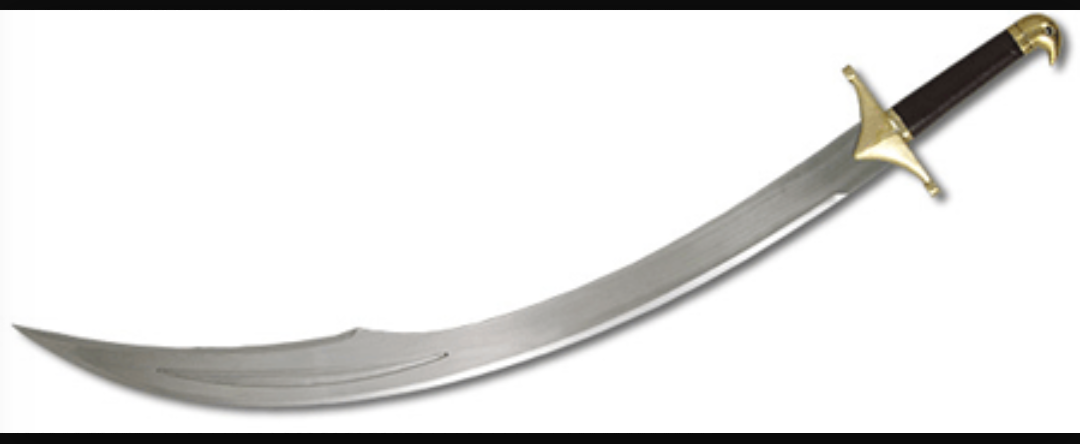
I'd love to take two comparable knives just to see but again I don't believe there'd be any real difference because the blades are straight and the grain wouldn't need to change directions at all.

Now I do believe in something like this there'd be an increase in crack mitigation if forged properly:
hB5PFFC.jpg
 
Why not get something simple made from the same steel?
For example 10 forged rings and 10 stock removed rings of the same dimension.
Normalise them.
Heat treat them the same and the subject them to so much pressure (and or pull) that they break.
Compare the required force and see who wins by what margin.

Might be a cool paper for some engineering/material science student.
 
For what it's worth, I offered my own stock-removal vs. forged challenge (we'll make a knife of the same steel from the same bar, and the same design, you forge one, I'll grind one, we'll let someone else test them both blind) many times in the past, and have never been taken up on it. Make of that what you will.

You can lead a horse to knowledge, but you can't make him think. Sometimes a man hears what he wants to hear, and disregards the rest.

Bodog, my offer still stands. Give me a heads-up if you're ever in the neighborhood. Other than that, I just don't have any more to add to this discussion. Unsubscribing in three... two... one... ;)
 
For what it's worth, I offered my own stock-removal vs. forged challenge (we'll make a knife of the same steel from the same bar, and the same design, you forge one, I'll grind one, we'll let someone else test them both blind) many times in the past, and have never been taken up on it. Make of that what you will.

You can lead a horse to knowledge, but you can't make him think. Sometimes a man hears what he wants to hear, and disregards the rest.

Bodog, my offer still stands. Give me a heads-up if you're ever in the neighborhood. Other than that, I just don't have any more to add to this discussion. Unsubscribing in three... two... one... ;)

Right on the money. But hey, what the hell do you know, you have only made several thousand knives. That can't compare to scientific data based on 400k psi forging machines the size of a house.:D
 
I can see where forging certain things would add cost-but for anything with a lot of dimensional changes (integral bolstered chefs knives, deeply curved shapes) the extra forging time makes up for the fact that you don't have to buy a 2" wide, 3/4" thick piece of steel and mill it out (i do my chefs knives out of 3/4" round 52100). I will say that by the time I've forged that roundstock down into a distalled tang that is 3/32" thick at the butt it is nigh undrillable, even after normalizing, sometimes after the first anneal as well, so something is changing. If forging has a real advantage it's in flexibility of materials-I can do an all steel tomahawk that is 6" spike to edge from a 2-1/2"x3/8"x10" piece of 5160. If I had to buy a 6" wide by 15" piece of steel that thick and then mill it to the proper distal tapers it would cost about three times as much.
 
An extreme example where with-grain is definitely tougher than end-grain (edge to spine orientation).

Take a standard sheet of heavily alloy banded (average 1.5" long section) and elongated aust-grain(1.5" long grain) steel. Cut two 1" wide bars. Bar Wg cut length wise (with grain), Eg cut across grain.

When as-rolled steel is harden: If Wg & Eg strike a sharp hard wedge with edge. Wg would be much tougher & stronger due to higher compressive strength and large impact dispersion along the bar rather than narrow propagation of force from edge to spine. Both alloy banding and mechanically elongated aust-grain contributed to this behavior.

After both bars heat treated - aust grain got reset, so mechanical/physical elongated aust-grain is gone. Alloy banding (from MC - primary carbides) still be there to negatively affect Wg less than Eg. Yes, alloy banding is undesirable, extra bad for Eg because impact force travel/propagate along hard objects, which could initiate cracks along and or at exit point.

Is there knives with 90* bend for this example to be 100% applicable? No but there is zero (flat edge) to some degree of bend/curvature. Metal wise in practice/reality, rolled metal whether ingot or PM(particle metallurgy) will have some degree of elongation and MC orientation. Of course, PM steels usually 99% free of alloy banding but they do have occasional clumping/aggregated carbides (google for such micrograph, you will see some scatter of large carbide - low variance but exists nevertheless).

Further more, if Wg & Eg cut from a wood board instead. Now, it's just common knowledge that Wg is stronger & tougher and readily/easily testable. Also we know to make a boomerang, using a heated-bend Wg piece definitely better than just cut a wood board to shape.

As for perfect-forging vs stock removal: Just apply various degrees of curvature, which really translate to impact dispersion size & shape. Indeed, large dispersion/absorption is better, where narrow propagation easily exceed yield strength which then initiate cracks.

Others stated before. Most forging is done on low Cr carbon steels. So alloy banding is none-issue. And today metals are mostly inclusion free. So expect perfect forging from hundreds+ hammer strikes would consider a statistically/probabilistically wishingful. Thus, one must accept some degree of mess-up from forging. If there isn't grain orientation involves here, forging vs stock removal is just a rhetorical exercise.

Otoh, on 3+%Cr carbon ingot tool steels (mostly high alloy), a good forger can reduce the negative impact of alloy banding by orient the banding with curvature of the blade and possibly break up some banding with hammer impacts. A minor unfavor condition when a large clump/carbide got flattened out spine-to-edge, essentially creating a end-grain orientation of hard objects.

For stainless & ultra high alloy steels, well forging is now in realm of specialty. 2% of perfect and 99% screw up (penalize an extra % for being crazy to forge stainless).
 
For those that are utilizing the stock removal method

Do you incorporate differential heat treat and distal taper into your work

These are the only advantages I see to the forged blade and than again it can be done with stock removal also
 
For those that are utilizing the stock removal method

Do you incorporate differential heat treat and distal taper into your work

These are the only advantages I see to the forged blade and than again it can be done with stock removal also
The differential heat treat-whether temper or harden-is easy enough to do on a stock removal knife.
Distal taper is soooo much easier to forge than grind.
There are some serious material cost savings from forging, either with significantly curved shapes, extreme dimensional variation, and especially stuff like 'hawks
To use my previous examples-this 52100 chefs knife image.jpgwas done out of 3/4" round. I went to price out a 5/8"x2-1/2"x14" piece (which is what you'd need to make it strictly stock removal) and Aldo doesn't even carry it. Ditto 5160 wide enough to cut out one of my hawks.
For fairly straight designs without distal taper there doesn't seem to be much point. There are a couple of bushcrafty knives I do out of 1095 that the only thing I would consider forging was the finger choil/tang taper-and if I didn't have a power hammer and a bit of a gift for simple tooling I might not even do that. For bowies, khukuri, bolo/parang and swords, i wouldn't considernot forging them.
 
Last edited:
The differential heat treat-whether temper or harden-is easy enough to do on a stock removal knife.
Distal taper is soooo much easier to forge than grind.
There are some serious material cost savings from forging, either with significantly curved shapes, extreme dimensional variation, and especially stuff like 'hawks

Yes

Hence the advantage I see in the forged blade

I see more forged blades that exibit these traits so I am drawn to them

For me it's not really a strength issue per say
 
For those that are utilizing the stock removal method

Do you incorporate differential heat treat and distal taper into your work

These are the only advantages I see to the forged blade and than again it can be done with stock removal also

Yes, assuming the design calls for it and the steel allows for differential temper (high-alloy steels simply don't work that way... ). A distally-tapered blade is pretty much required for a whole lot of blade designs to really perform properly, as well as for purposes of balance.

Not to flog a dead genius, but people tend to forget that stock-removal makers have been tapering tangs at least since Bob Loveless made it popular... although of course those kind of tapers started centuries before the modern era, being forged in.
 
Yes, assuming the design calls for it and the steel allows for differential temper (high-alloy steels simply don't work that way... ). A distally-tapered blade is pretty much required for a whole lot of blade designs to really perform properly, as well as for purposes of balance.

Not to flog a dead genius, but people tend to forget that stock-removal makers have been tapering tangs at least since Bob Loveless made it popular... although of course those kind of tapers started centuries before the modern era, being forged in.

Yes :)

I will not purchase a full tang knife unless it has a tapered tang

Just me :)

Nothing is new in blade craft except the steels used

Even fullers are making a come back :)
 
Differential temper is done with stock removal. However, I did not know that stock removal does not allow for distal taper? I mean, isn't the crowell bowie by Browning distal taper? I know that is not hand forged.
 
I know that Differential heat treat can be done on stock removal but it is more prevelant in forged blades as well as Distal taper

The Browning knife I believe has a Tampered tang but I'll have to look I have one around somewhere

The kind of radical distal taper I am speaking of is most prevelant in forged blades and not many production blade reach that level

Grinding can produce it but I'm speaking of the taper starting at the guard and proceeding deepen the blade not a ground clip or swedge
 
Yes, assuming the design calls for it and the steel allows for differential temper (high-alloy steels simply don't work that way... ). A distally-tapered blade is pretty much required for a whole lot of blade designs to really perform properly, as well as for purposes of balance.

Not to flog a dead genius, but people tend to forget that stock-removal makers have been tapering tangs at least since Bob Loveless made it popular... although of course those kind of tapers started centuries before the modern era, being forged in.

Very true-i just don't want to have to grind the distal in-especially on anything over 7" or so...and that's just because I'm not wild about grinding.
(I also have about 500lbs of virgin 5160 in 5/16"-3/8+x20" or so by 2-1/2...that only cost me the spring I broke in my truck (lol-not) getting it home. Unused, verified-by-the-manufacturer 5160...which i would not be able to use very effectively if it wasn't gonna get beat. I do both-depends on the design, the steel and the size.
I do like to hit things with a hammer, though. It's very soothing...
 
For that matter if you have a good eye and feel for balance you can fiddle the balance of a full-thickness tang pretty effectively by drilling it out just right. I tend to drill even my distalled tangs-The stuff I make likes a pretty aggressive forward lean.
 
The Browning knife I believe has a Tampered tang but I'll have to look I have one around somewhere.

My example of that knife is fully tapered all the way down the tang and from the plunge all the way to the tip.

Full tapers are somewhat rare on handmade stock-removal knives because they take more time, and extremely rare on production knives because they require too much hand work. Frickin' robots...

They're also rare on bushcraft and especially "survival" knives, handmade or not, because so many customers are deathly afraid of breaking a tapered tang somehow... what they don't realize is that most of them are so drilled-out to save weight, there's actually less steel in them than a proper hidden tang... but it looks thick from the outside, so that puts their mind at ease. *shrug*
 
Back
Top