Framelocks are finicky at best, they wear extremely quickly and if you want one to last it should never be subjected to stress intentionally.
Every time you apply shock or heavy pressure to a framelock it wears out a little more. That does apply to most other locks too, but the framelock (and linerlock) design is inherently much less stable than something like the Axis lock.
The reason manufacturers put framelocks on "hard use" knives is because the average customer values aesthetics and convenience over security. All your beefy framelock knives are like a cosplay version of Batman. Good for looks, nice to play with on the couch, but they will quickly fall apart under stress.
Yes, framelocks can be made strong, but then they're hard to unlock. In this design convenience and reliability are directly opposed, and people complain bitterly when convenience is compromised, so knifemakers give people what they want, aesthetically pleasing weak locks.
Simply put "framelocks sell", even if for all the wrong reasons.
(Edited for paragraphs)
That is my general impression of them as well, framelocks in particular. What makes it worse are the attempts to overbuild them, which increases rigidity: Flimsy liners will actually not wear the contact surfaces as much as the more rigid framelocks, because they have thin flexible bars that relieve impact wear on the locking surfaces.
Also what is overlooked is that a narrower stock, "flimsier" liner lock generates a more "biting" friction on the contact surface, just from being a narrower, flimsier piece made of harder materials: This combines two things: Less slippage from the narrowness of contact (especially if the end is roughly finished), and less concentration of force from the overall flexing: Flimsier bars take the slippage tendency away from the locking surface, by bending, which is exactly what framelocks don't do: They
concentrate the effort on the locking surfaces, hence more wear/slippage...
Framelocks are also much more rigid on impact, so all the forces again get concentrated on the locking surfaces.
This was brought home to me when Cold Steel tested the Sebenza, and it failed the handle weight test at around forty pounds (which I pointed out was about the weight of the DA trigger of a Walther PPK, or at least the CZ 50 I used to have)... There was a bit of an issue of measuring the distance from the pivot to the weight attachment, if I recall... I don't have the greatest confidence in Cold Steel tests... But generally it was acknowledged the frame lock design was far from the greatest for strength, reliability, and that failing the spine wack test was common... I found this surprising.
The better argument in favour of frame locks is that with the hand holding it tightly it will hold up better: This may be true, but it does not inspire great confidence...: I think framelocks and even liner locks would be better suited to slim folders that do not project an image of great "strength": In the case of many overbuilt framelocks, there is a great discrepancy between the knife's appearance and its actual ability, which is an invitation to an accident.
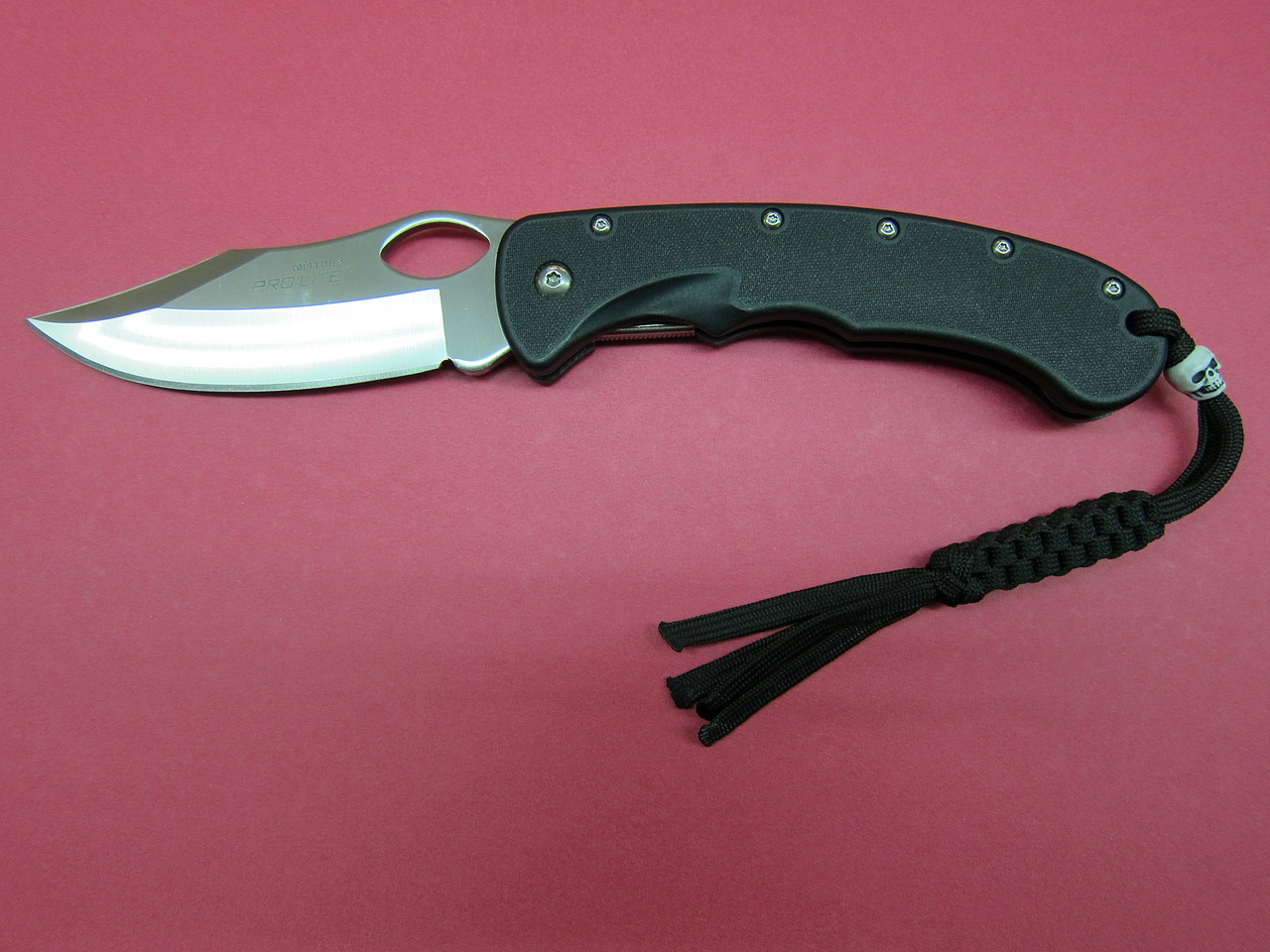
As far a spine wacking being a useless demonstration, I only remembered later an incident where my Cold Steel Pro-Lite really saved a trip: My bike chain had jumped off the gear wheel and wedged itself between the frame and gear assembly: It had been wedged there by the force of my full force pedalling being abruptly stopped, so you can imagine the energy...
Because of the narrow space, the only tool I had that could reach in there, and tap the chain free, was my Pro-Lite's
spine...: A somewhat beefy liner lock folder, with a curious "double hump" bowie blade and a very functional oval opening hole (which I liked better than a round hole), probably one of the best liner lock folders of the time (around 2000): I proceeded to spine wack it about a hundred times to free the chain, spinning it full force by the tip of the handle: Finally, after all that tapping, the chain came free and the trip, hundreds of miles from home, was saved... (Otherwise the bike's rear wheel would not even turn, so I could not even push it besides me as I walked: It would have had to be
carried: That meant abandoning it...)
Not my actual knife:
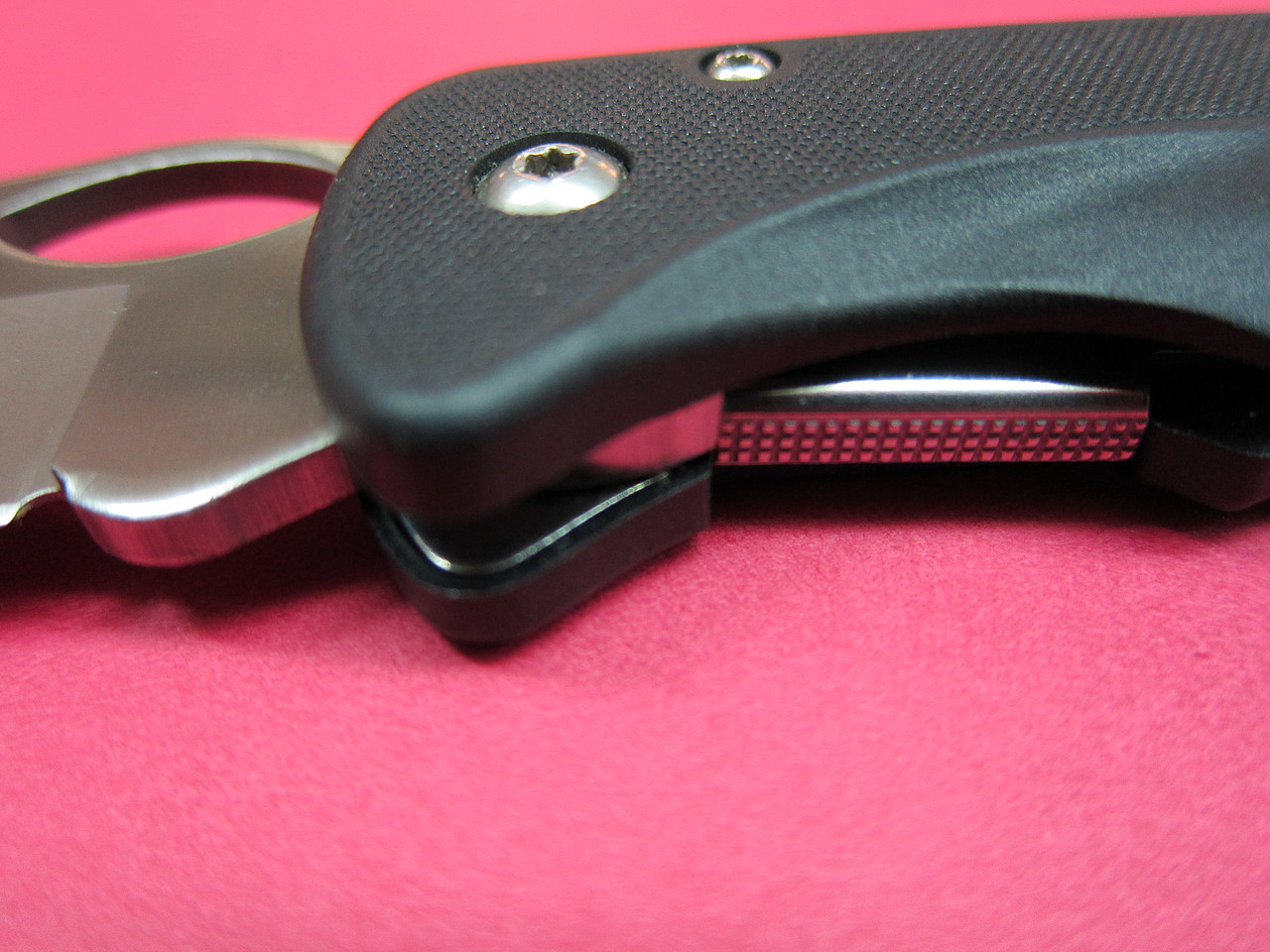
A pretty beefy lock at the interface, but elsewhere the liners are thin throughout, so again
not the rigid bar/faraway flex point of a framelock:
I would say generally, because of this built-in flexibility issue, that thin-bar liner locks are probably better in reliability than framelocks, which is the opposite of the impression they make... I still do not like that, on linerlocks, the all-or-nothing ball detent "step" is the only real safety feature keeping the knife closed: After decades of carry, an oddball incident will eventually jar it open... Lockbacks keep a continuing closing pressure, which is the big reason to choose them.
I have to say that, as I wacked the Pro-Lite's spine a hundred times as hard as I could, it never occurred to me that a linerlock, or a lockback for that matter, could slip... This being around 2000, I had fifteen years to wait to first hear of the spine wack test, and of failures doing this... I do however remember in the 90s hearing about liner locks opening in the pocket, and of this being considered a common issue...
Gaston