First knife build need help

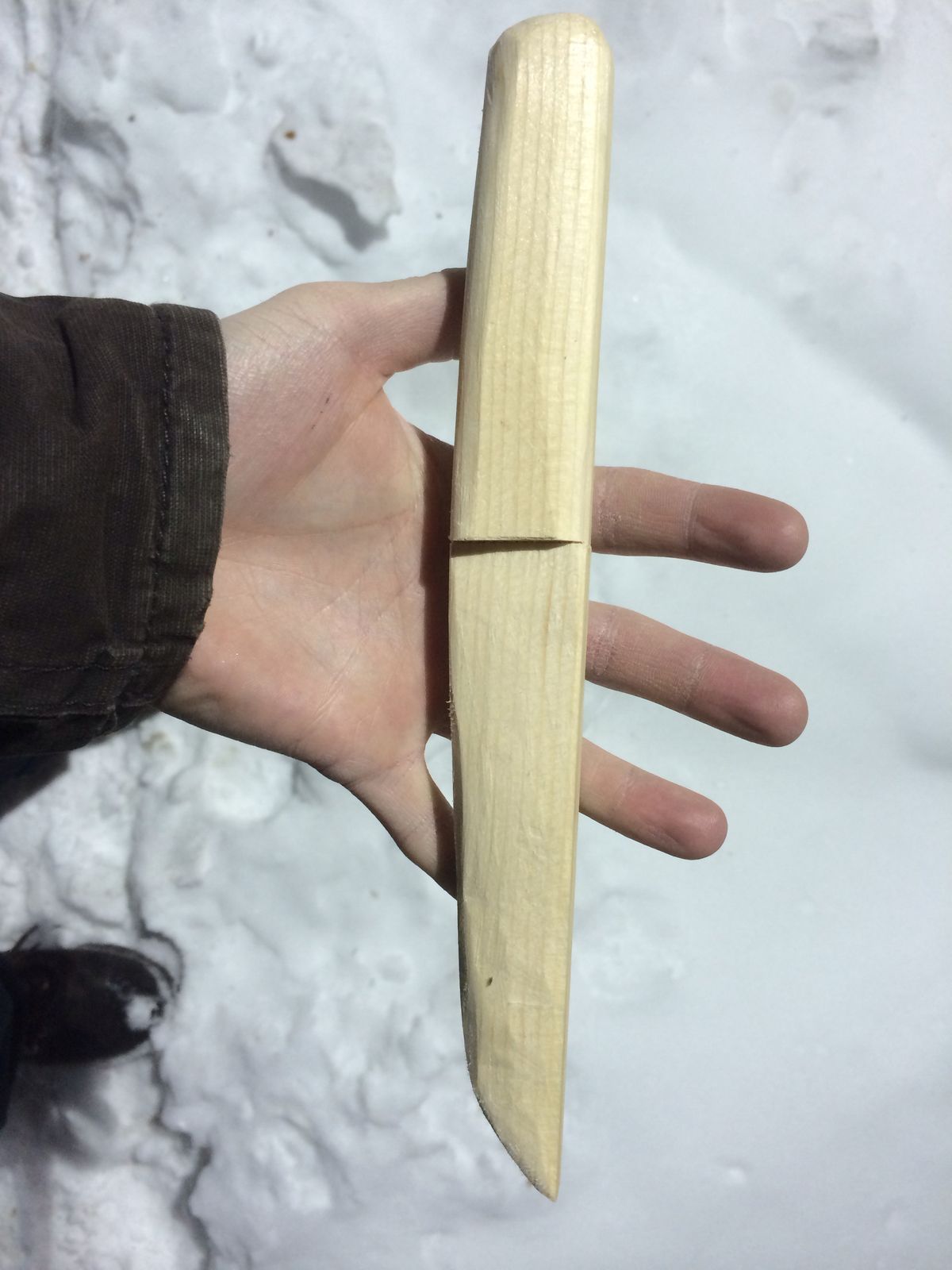
Why is it the more mock ups I do the simpler the design becomes? I've gone from something that looks like a shortened chefs knife with a curved handle to something more along the lines of a straight short tanto. Ah well my nephew enjoys getting new toys lol. And how would 1095 in 1/8" fair? Getting impatient waiting for the cpm 154cm.
 
The designs get simpler because you are allowing form to follow function I bet. IMHO it means you are whittling down to a comfortable design. If its comfortable, you will use it more. Its a good thing...

I use 1095 for probably 90% of my blades. It is more finicky with HT than some of the other simple carbon steels, but holds a terrific edge and is versitile and very robust. Corrosion can be an issue if neglected, but with proper maintenance I have never had a customer complaint. Even here in the humid south. It is pretty cheap and grinds/drills/files nicely in its annealed state.

If you are having to wait for steel for some odd reason, I happen to have a good bit of 1095 on hand. It is 2"x3/16" stock but is Aldo's 1095 and is predictable. How much you need? I start thick and either forge down or grind down depending on my desired end thickness. 1/8" is plenty thick though... Becker, for example, uses ~1/8" on their BK-7 and it is plenty stiff.
 
Thanks for the offer but I haven't seen the cpm 154 cm in stock so I'm opting for the 1095 in its place. Just debating getting one piece or two since like someone said earlier I'm paying shipping anyhow. And I'm still trying to find a thread I saw a while back of a simple tanto style knife for reference on the blade and handle layout.
 
Thinking getting a 1/8" and 3/16 piece. Any advice(looking your way on this Eric)? And the blade design I've decided to go with is a short straight tanto with a blade length of about 5" and handle of 3 1/4" for an OAL of about 8 3/4". I'll post pictures once I put it from mockup to paper.
 
Last edited:
For my hands, 4" is minimum for a handle. But, if you are going for a three finger knife that would prob be ok... Tanto blades have their drawbacks. They make awesome penetration devices, but tend to lose out from the lack of belly or any curved sections. But, I know plenty of guys that carry a variation of a tanto blade for almost everything...

I go 1/8" on anything that I wouldn't consider heavy service. 5/32-3/16" for my blades that will be battoned through wood or the like. No differential HT either, tends to make the spine mushroom out. So, you have to make up for it with a little thickness but it works just fine. Post up a sketch!!
 
Just remeasured the handle and it's 4 1/4". Did it the first time using my hand.
eef52564b7b69276b35d21d8c97f8024.jpg
 
Ah. Yeah, I was thinking that was a tad short or you were a smurf.

My $.02... If you go tanto with it, stick to the curve like you have on your mock-up. More of what would be considered a Japanese tanto profile. It is a bit easier to grind, and as the surfaces 'flow' into one another it is a more versitile blade. It still allows you to use what belly it has, and the flats are not so dead flat they are inefficient.

With the handle, just consider if retention needs to be addressed. Consider a steel knife with stabilized or synthetic handles will be heavier and slicker. A slight swell at the front and rear of a grip is all that is really needed to keep the knife where it should be in your hand.

Just a tip. Keep your mock-ups. There have been a couple of times I had a blade shape I liked with a bad grip or vice-versa. Handy to dig em up. Another member here (sorry, can't recall who,) uses thin veneer or laminate for templates. Then will cut the blade and grips apart to use in other designs. Pretty handy...
 
Awesome :smile: If I mess with the point I think the only thing I'll change is round it up like the tweak you dud to the original sketch. Time to order steel . I'm thinking this one will be more focused on fit and finish. The more I think about it the worse I feel about beating the heck out of it in the woods. Might just use this as more of a utility knife than anything outdoors. Not to keen on working it to a mirror polish then splitting firewood with it lol.
 
Last edited:
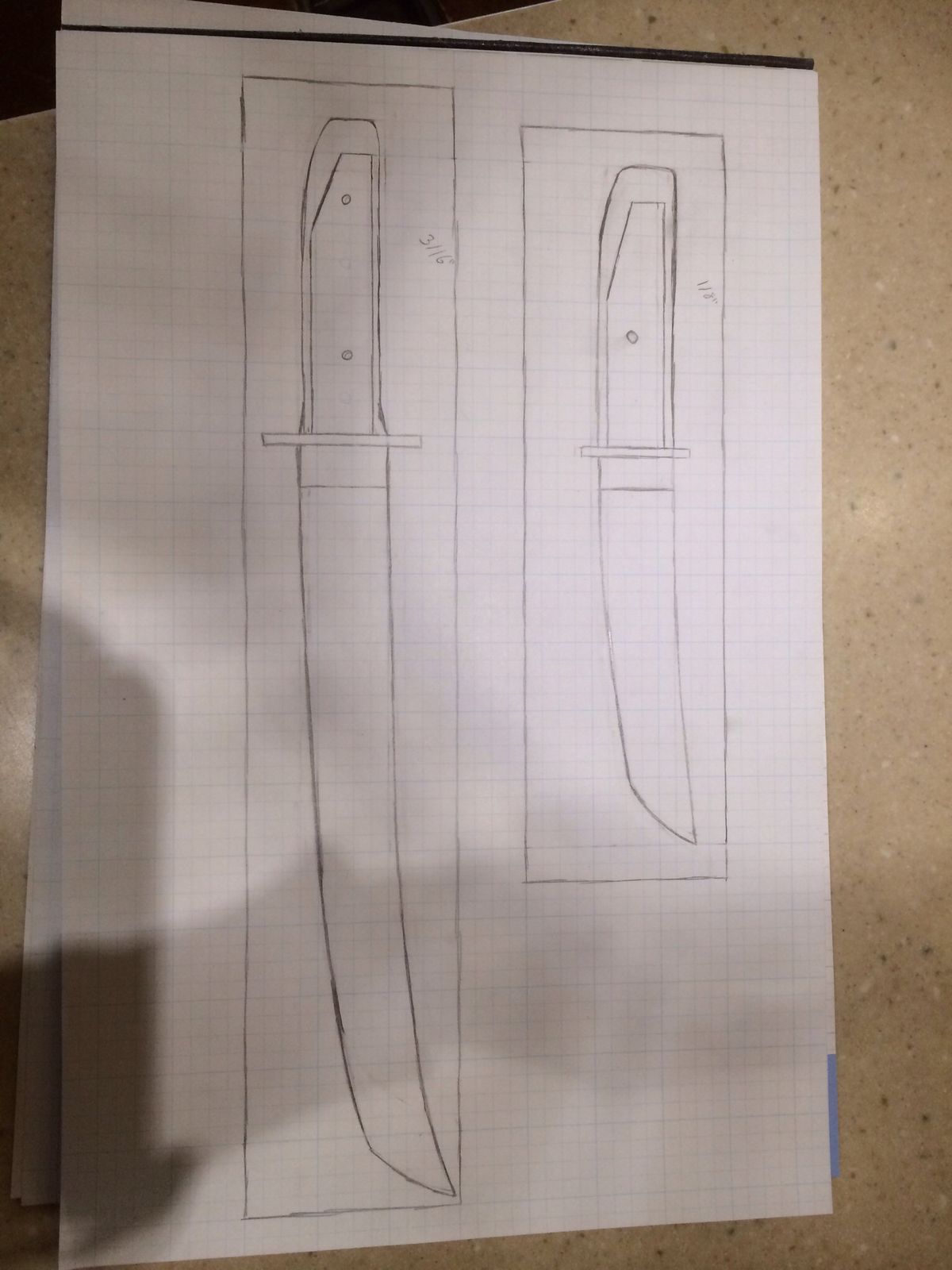
Ok got it on paper still working out a few handle ideas but liking the blade shape and size.
4205d04ee4a2ab4c6b589f27ca116432.jpg
right is the main project. Left was boredom and toying with the idea of a matched pair( basically a tanto pig sticker since the hogs are now in michigan)
 
Last edited:
You're starting to get into Stacy's repertoire and out of mine ;)

Stacy is up to speed on the size/shape/construction of all things Japanese. Drop him a PM and he can give you the low down on all the do's and don'ts of Tanto's, Wakizashi's and Katana's... My milieu is more the traditional or old school look...
 
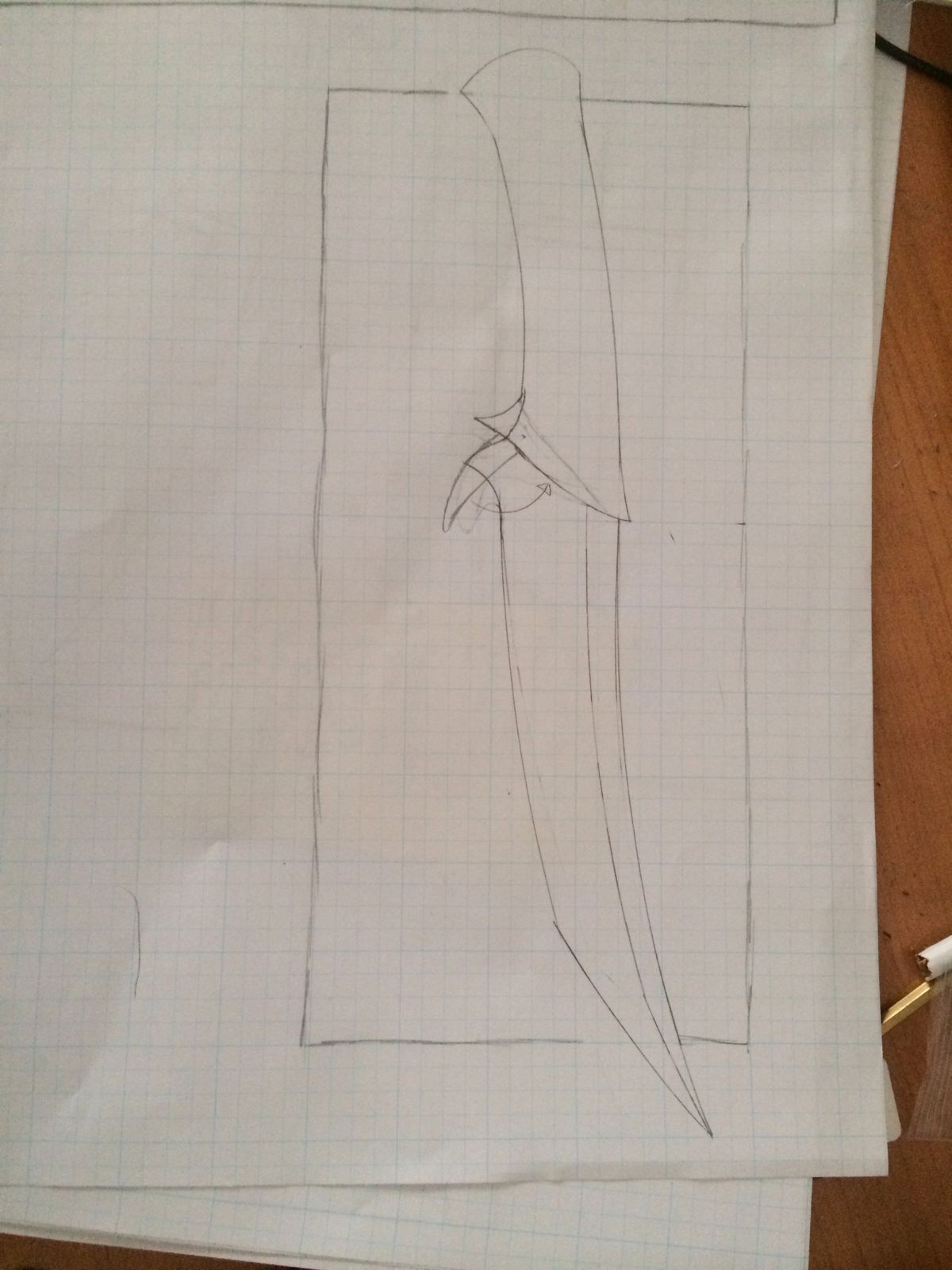
Quick question. Ever since you mentioned having a knife that could do all you wanted in the woods I had the idea rolling in the back of my mind and came up with a couple ideas. Have you thought about making a mechanical gut hook by means of a curved piece of metal that dropped down by the ricasso and bringing the ricasso down to almost a second point with a bit of a curve?
 
Go to your user page. On tapatalk touch the T in the corner, on a computer, upper right where is has 'user profile'. Then go to messaging. Or, you can find the user you want to PM, click their avatar and it will take you to their user page. Messaging is there... if they accept PM's. Most maker level members do FTMP.

I put a guthook on my bush/hunting knife I did a couple of years ago. Just on the back of the blade... It works, but not as well as my stand alone Gerber zipper. I have thought about making a matching pair of knives. Hunter/camp knife with a small utility/guthook blade with a more T shaped hande. Are you talking about grinding it into the ricasso or actually having a fold out blade near the handle?
 
I'll sketch it up in the morning... Or rather after noon now. Gotta love working nights lol. But I'm basically looking at the guy hook design as two parts. The usually straight inner unsharpened side and the somewhat curved cutting edge. But for ease of use making the unsharpened part fold away into the front of the handle or slide along it.
 
Without some practice and skills, that handle you drew will be hard to fit on the nakago ( tang).
I would do one of three things on a first knife:
1) Make the handle a full tang type. It will be much easier to fit than trying to hollow out the seat and have very thin sides.
2) Make the handle a paracord wrap style. This goes well on a tanto style, and is easy to do. You can wrap ir a dozen times if needed until you get what you want. Once it is right, just apply a light soak of epoxy and the handle is permanent. Read up on "paracord wrapped handle", "cord wrapping", and similar searches.
3) Make the tang a normal stick tang and do a normal hidden tang handle construction. This is also the easiest choice.

If that is just a ricasso in the drawing, it will be no problem to do. Some people call a solid ricasso made to look like a habaki a "faux habaki".
If it is a habaki ( blade collar) then you will need the skills and tools to make one. It isn't hard with the right tools, but it isn't a beginner project.

If you decide to make a hidden tang handle ( best idea), or even a full tang, here is a trick for getting it perfectly shaped and sanded:
Fitting the handle up against the tsuba ( guard) on any knife can be difficult. It is hard not to scratch up the guard, and the handle almost always is poorly shaped where the two meet. The trick is to make and fit the guard, and then set it aside. Make a second guard out of masonite. Micarta, or wood. It does not need to be shaped like the guard, just fitted to the tang right now. It does need to be the same thickness as the guard, or a tad less ( but no more). Place the "work guard" on the knife and fit the handle block to the tang. Once it is fitted, and any holes are drilled, start shaping it. You can wedge a few strips of paper in the guard slot to hold the handle in place, but what I do is make a temporary wooden pin ( mekugi) for the handle and put it in where the pin(s)/rivet(s) will be. This keeps the handle and guard snug and allows shaping of the handle. Just shape the work guard piece to match the handle...don't have it stick out any. This allows the handle to be fully shaped and sanded until it is done. If applying a finish, you can do that now, too. Once the handle is done as much as you want. Carefully knock out the wooden pins. If they won't come out because of the finish making them stuck, carefully drill them out with a drill bit or Dremel tool burr. Remove the handle and place the real guard on the knife. Put on the handle and check the fit and alignment of the pin hole(s). If all is well, you can glue up the handle, install the pins, rivets and finish the knife. If the handle is a tad too snug, carefully file the end to make the pins align with the holes. If it is too loose, make a thin copper (or other material) spacer to go between the handle and the guard. This spacer is called a seppa.

 
Last edited:
Thank you bladsmth I was thinking something like a metal guard like you mentioned or the para cord wrap. My only question with the para rod is I've seen some where it looks like it's built up to almost a ball before the blade and was wondering if that is all wrap or if there's something underneath I'm not seeing. Thank you again I'll probably go with your idea of a pinned handle and guard. On a side note what would you recommend for a sheath. Not a big fan of leather and kydex seems like a royal pain.
 
Here's the rough idea Eric. My thought on it is having the gut hook on the bottom like that and relying on the last 1/2" or so of blade keeps it both unused except for gutting and allows the knife to go back to full function after your done . The end in this I was thinking if it's possible and doesn't cause issues in ht could be used like a fillet knife. Once again just an idea.
e978e27133eccf04bdb0227f1a47a417.jpg
 
Back
Top